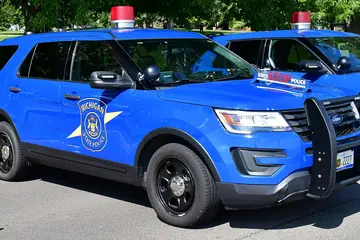
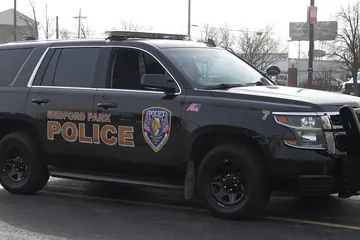
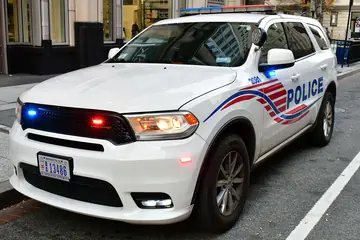
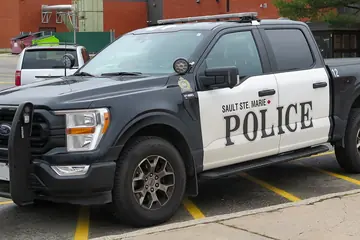
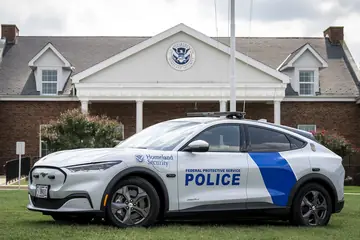
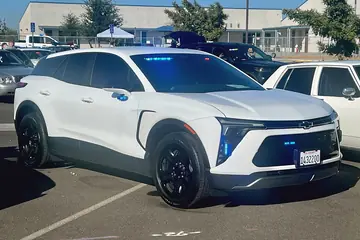
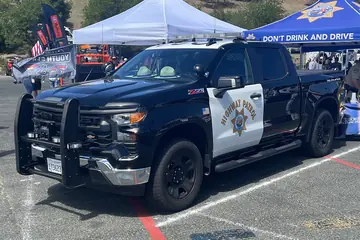
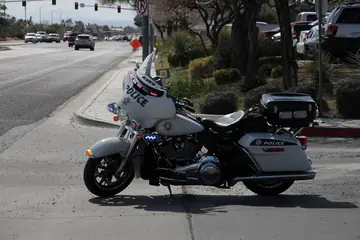
Eight police vehicles on I Go Cars remain available to agencies as new vehicles: seven sport utility vehicles, pickups and crossovers, plus Harley-Davidson's police motorcycles. Not one of them is a sedan. Seven carry the verdict In production for police, and one, the Ford Mustang Mach-E, carries Special service only, because Ford sells it for police duties that do not require pursuit capability rather than as a pursuit-rated vehicle.
The current fleet is a utility fleet
The clearest single picture of the current market is the list of patrol vehicles the Michigan State Police (MSP) tested for the 2026 model year. There were 13: two versions of the Chevrolet Tahoe PPV, two of the Chevrolet Silverado PPV, the Chevrolet Blazer EV PPV, two engines in the Dodge Durango Pursuit, a Ram 2500, three powertrains in the Ford Police Interceptor Utility, the Ford F-150 Police Responder and the Ford Mustang Mach-E GT. MSP also tested five motorcycles. Every patrol vehicle on that list is a utility vehicle, a pickup or a crossover.
Within that fleet, one model dominates. Ford claimed in January 2019 that its 2017 Police Interceptor Utility accounted for more than half of all U.S. police vehicle sales; that is a manufacturer claim, not an independent count. Agency records point the same way. Seattle's patrol fleet went from 268 Crown Victorias at year-end 2012 to 272 Police Interceptor Utilities at year-end 2020, and Washington State Patrol reported the Utility as more than 70% of its pursuit fleet.
Pursuit-rated and special service
A pursuit-rated vehicle is one its manufacturer designates for police work up to and including high-speed driving. GM's specification guides use the phrase "designed for police work up to, and including high-speed emergency vehicle operations." No outside body awards the rating. MSP says the more accurate term is "pursuit capability," because there is "no sanctioning body, or specific performance criteria," and it states that meeting its own purchasing criteria does not certify a vehicle as pursuit-rated.
A special service vehicle (SSV) is a police configuration built for non-pursuit duty: command, prisoner transport, towing, hauling equipment. GM sells both kinds side by side. The Tahoe PPV (package 9C1) is pursuit-rated, while the Tahoe SSV (package 5W4) is rated "for off-road and non-pursuit operations" and is built only with four-wheel drive; the Silverado follows the same pattern. Agency policy then governs how each is used. The Los Angeles County Sheriff's Department, for example, bars SUVs, vans, pickups and service vehicles from pursuits "except under the most compelling circumstances."
The Mach-E sits on the special service side of that line. Ford lists the Mustang Mach-E GT under Special Service Vehicles, and a Ford fleet manager told POLICE magazine in 2022, "We don't actually have a Mustang Mach-E police package." Agencies upfit the civilian vehicle themselves, which is the reason for its verdict.
How the current vehicles compare in testing
MSP tests every patrol vehicle with a clean roof (no light bar, spotlights or other emergency equipment), so the figures below describe vehicles lighter and cleaner than an equipped patrol unit. MSP warns that equipped performance "may be lower than reported." In the model year 2026 results:
- The Ford Mustang Mach-E GT reached 60 mph in 4.03 seconds, the quickest patrol vehicle in the test, with a 124 mph top speed and the shortest stopping distance in the overview table.
- The Chevrolet Blazer EV PPV reached 60 mph in 5.14 seconds and a limited top speed of 130 mph.
- The Ford F-150 Police Responder reached 60 mph in 5.68 seconds and 121 mph.
- The Ford Police Interceptor Utility with the 3.0L EcoBoost reached 60 mph in 5.95 seconds and 148 mph, and posted the fastest lap time in the overview table.
- The Dodge Durango Pursuit 5.7L reached 60 mph in 7.24 seconds and 130 mph.
- The Chevrolet Silverado PPV reached 60 mph in 7.29 to 7.37 seconds and 114 mph.
- The Chevrolet Tahoe PPV with rear-wheel drive reached 60 mph in 7.39 seconds and 130 mph.
Speed is not the whole picture. The same Mach-E that led on acceleration and braking scored 5.33 for communications and installation, the ease of fitting radios and emergency equipment, against 8.71 to 9.78 for the other vehicles. For the Harley-Davidson Road Glide, OFFICER magazine reported MSP's 2026 motorcycle result as 5.05 seconds to 60 mph and 119 mph; that figure comes from the magazine's report rather than the test book itself, and the profile says so.
Electric and hybrid police vehicles
Two of the eight vehicles are battery-electric, and they illustrate the difference between the two verdicts. GM announced the Blazer EV PPV in 2022 as "the first pursuit-rated all-electric Chevrolet in more than 60 years," and lists it among its pursuit vehicles for 2027. The Mach-E is in police service but is not pursuit-rated. The Ford Police Interceptor Utility, meanwhile, uses a 3.3L hybrid as its standard powertrain. Ford's internal telematics, which are manufacturer data rather than an independent study, put the hybrid at 0.75 gallons per hour of vehicle use against 1.23 gallons for the 3.3L gasoline engine, largely by running police electrical loads from the battery at idle.
What "in production" does not settle
A current verdict says nothing about whether a model is trouble-free. The Dodge Durango Pursuit is the clearest example. An FCA customer satisfaction notification, 58B, covers about 21,051 Durango Pursuits with the 5.7L engine, whose coolant pump "may cause a pin hole in the oil cooler due to cavitation." Indiana State Police, which bought 516 Durangos, reported 39 out of service with oil-cooler failures by June 2024. Those records are a service notification and a technical service bulletin, not an NHTSA safety recall, and the Durango profile describes them in those terms.
The vehicle itself is also only part of an agency's cost. Seattle's city auditor found the city paid about $86,836 per 2020 Police Interceptor Utility, with 56% of that figure going to upfitting (the lights, partition, consoles, radios and wiring an agency adds after delivery). That is one city's figure for one year, not a current price, but it shows why the base vehicle is often the smaller share of the bill.
When a current vehicle reaches the public
Every vehicle in this group is sold new only to agencies and fleets; GM, for instance, states that police Tahoes "are not to be sold to retail customers." A member of the public meets one only after an agency retires it, typically on a schedule measured in miles, years or both. Newport Beach, California replaces patrol units at 75,000 miles or four years, while Washington State Patrol averaged about 118,000 miles at replacement in 2018 and 2019. The profiles explain what that service life leaves behind, including idle hours that the odometer does not record.