What Harley-Davidson police motorcycles are, and their status
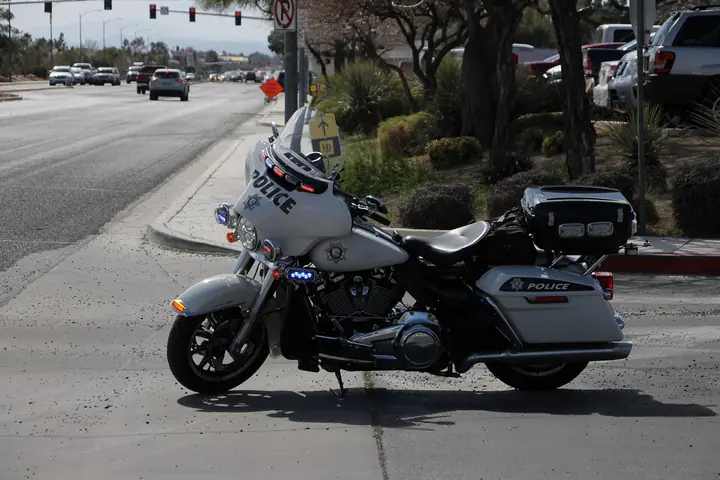
Harley-Davidson police motorcycles are the duty versions of Harley-Davidson touring and adventure models, built with duty equipment and sold to law enforcement agencies for traffic enforcement, escort and patrol work. They are one make of police motorcycle, the general term for a motorcycle equipped for law enforcement, and Harley-Davidson's law-enforcement page carries the tagline "Answering the call since 1908."
They are in production for police. That page, checked in October 2026, lists two current models: the 2027 Police Road Glide and the 2027 Police Pan America. The company says it has supplied motor officers (the term for officers assigned to motorcycle duty) "for more than 110 years."
What has changed is the lineup. From the 2008 lineup through the 2024 model year, Harley-Davidson's duty touring range included the Police Electra Glide and the Police Road King. Neither appears on the current page, and the Road Glide, a different touring design, has taken their place at the top of the range.
The current lineup: Police Road Glide and Police Pan America
Police Road Glide (FLTRXP). The 2027 Police Road Glide (spec-sheet filename MY27-FLTRXP) uses the Milwaukee-Eight 121 VVT engine, which Harley-Davidson's page says replaces the Milwaukee-Eight 114. Its defining feature is a fixed fairing, meaning the windshield and front bodywork do not turn with the handlebars. OFFICER magazine (a trade publication for law enforcement) reported that it "features a fixed fairing and differs from the company's past Police Electra Glide and Police Road King," and that Michigan State Police riders noted "a lot less wind buffering."
OFFICER's November 2024 report on the MY2024 Road Glide lists duty features that matter in daily use:
- Cornering Enhanced ABS and linked braking;
- traction control;
- a "trigger switch" that "allows approx. 15 minutes of power to police emergency equipment with ignition off," so lights and radio can run at a traffic stop without the engine.
Police Pan America. The second current model is the duty version of the Pan America. Harley-Davidson's page says its "liquid-cooled Revolution Max 1250 cranks out 150 HP." No Michigan State Police test data or detailed specifications for the Police Pan America were found for this page, so its test performance is not documented here.
Police Electra Glide and Police Road King: the models still in service
The Police Electra Glide (FLHTP) and the Police Road King (FLHP) were the backbone of American motor units for years. Harley-Davidson's 2008 lineup, announced in its 100-year police release in September 2007, was the "FLHTP Electra Glide, FLHP Road King, TLE Sidecar and XL 883 Sportster." The MY2024 duty models named in a 2024 warranty announcement were still the Police Road Glide, Police Electra Glide and Police Road King.
By the 2027 model year, only the Road Glide and the Pan America remain on the page. Harley-Davidson has not published a dated statement that the FLHTP and FLHP are discontinued for new agency orders, so the accurate description is that they are absent from the current lineup. They have not left the road: many agencies still run them, as Jalopnik has reported. A reader who sees an Electra Glide or Road King on duty today is looking at a model Harley-Davidson no longer lists for law enforcement, not at a current one.
Scale is harder to pin down. In its 2007 release, Harley-Davidson said "more than 3,400 U.S. police departments ride Harley-Davidson motorcycles" and that its bikes were used by departments in 45 countries. Those are the company's own figures and are now nearly two decades old; no current count was found.
History: Detroit in 1908, Berkeley in 1911
Harley-Davidson states that "the first Harley-Davidson police motorcycle was delivered to the Detroit Police Department in 1908," and its police tagline rests on that date. The claim is not universally accepted as the start of motorcycle policing. The National Motorcycle Museum calls the Detroit story "Harley-Davidson lore" and dates the first official motorcycle patrol to 1911, in Berkeley, California, under Chief August Vollmer. Wikipedia's police motorcycle article reports both: Harley-Davidson credits Detroit as the first purchaser in 1908, and Berkeley "officially organized its police motorcycle patrol in 1911." Both statements can be true at once. One is a sale, the other is the formation of a unit.
The machines of that era bear little resemblance to today's. A 1909 Harley-Davidson single police motorcycle described by the museum had an engine of about 30.2 cubic inches (494 cc), about 4.3 horsepower, belt drive and coaster-type brakes. The 2027 Pan America claims 150 horsepower.
Performance: Michigan State Police MY2026 testing, as reported by the trade press
The Michigan State Police (MSP) Precision Driving Unit has tested duty motorcycles alongside patrol cars for many years; a 2017 National Institute of Justice summary counted 66 motorcycles among the 275 vehicles MSP tested between 2002 and 2017. For model year 2026, MSP tested 13 patrol vehicles and five motorcycles: three BMW R 1300 RT-P units (RT-P is BMW's designation for the law-enforcement version of its R 1300 RT touring bike), the Harley-Davidson Road Glide and the Honda NT1100. Unlike MSP's patrol cars, which run with a clean roof, the motorcycles were "tested with equipment installed as provided by their respective manufacturers."
A sourcing caution. The figures below were not read from the MSP test book itself. They come from OFFICER magazine (Dec. 16, 2025) and Government Fleet (Dec. 1, 2025), two trade publications that reported MSP's results, and they should be read as those outlets' figures. As reported by OFFICER:
- Harley-Davidson Road Glide: 0-60 mph in 5.05 seconds, 119 mph top speed, 24.52 ft/s² average deceleration, 157.94 ft projected stop from 60 mph.
- Honda NT1100 Police: 4.16 seconds, 119 mph, 27.53 ft/s², 140.64 ft.
- BMW R 1300 RT-P, three units: 3.61 to 4.38 seconds, 136 to 148 mph, 27.52 to 29.12 ft/s², 132.97 to 140.68 ft.
The BMW top speed is in conflict between the two outlets. OFFICER lists 148, 136 and 136 mph for three BMW units, identified only by unit number and not matched to BMW's Dynamic, Standard and Auto Shift packages. Government Fleet reports a single figure of 141 mph for the BMW R 1300 RT-P, describing it as the fastest. Government Fleet may be reporting an average or one unit; the sources do not say. Both outlets agree on 119 mph for the Road Glide and the Honda.
Read plainly, the Road Glide was the slowest of the five to 60 mph, tied the Honda for the lowest top speed and had the longest projected stop. That is a measurable gap, not a verdict on the motorcycle. MSP's motorcycle program measures acceleration, top speed and anti-lock braking only; it does not score comfort, ergonomics, dealer support or cost, all of which agencies weigh. The one rider observation reported, less wind buffering on the fixed-fairing Road Glide, is exactly the kind of factor those numbers leave out.
The Road Glide is new to MSP testing for 2026; earlier Harley entries were the Electra Glide and Road King. In MSP's MY2019 tests, reported by Government Fleet in 2018, the field included the H-D FLHTP, FLHP Stage 1 and FLHTP Stage 2. The quickest bikes that year were the Yamaha FJR1300AP (3.78 seconds, 144 mph) and the BMW R 1250 RT-P (4.03 seconds, 137 mph).
How agencies choose, and what the data does not show
BMW is the other major make in American law-enforcement motorcycling in the sources used here. More than 225 US law enforcement agencies, including the California Highway Patrol, field BMW authority motorcycles, according to Wikipedia's police motorcycle article, and BMW premiered the R 1300 RT-P in the US to the Los Angeles County Sheriff's Department, the LAPD and 19 other agencies. The sources show that BMWs outperformed the Road Glide in MSP's MY2026 acceleration and braking tests. They do not record why any particular agency chose one make over another, and no motive should be read into the test results alone.
MSP itself makes no choice for anyone. Its model year 2026 book publishes data and states that there is no sanctioning body for a "pursuit rated" designation. Agencies make their own decisions from the data, their budgets and their riders' experience.
Motorcycle duty also carries real risk. The National Law Enforcement Officers Memorial Fund's preliminary count for 2025 recorded 34 traffic-related officer deaths, of which seven were motorcycle crashes. That figure covers all makes, not Harley-Davidsons alone.
Common misconceptions
"The Electra Glide and Road King are Harley's current police bikes." Harley-Davidson's law-enforcement page now lists only the 2027 Police Road Glide and Police Pan America. The Electra Glide and Road King remain in service at many agencies but are absent from the current lineup.
"Detroit in 1908 was the first police motorcycle unit." That is Harley-Davidson's claim about its first sale to a department. The National Motorcycle Museum calls it lore and dates the first official motorcycle patrol to Berkeley in 1911.
"MSP ranks or approves motorcycles." MSP publishes test data. It does not rank, approve or certify, and it says there is no sanctioning body for pursuit ratings.
"The MY2026 motorcycle numbers come straight from the MSP book." The figures widely quoted, including those on this page, were reported by OFFICER and Government Fleet, and the two outlets disagree on the BMW's top speed.
Frequently asked questions
What Harley do police use?
Harley-Davidson's current duty lineup is the 2027 Police Road Glide, powered by the Milwaukee-Eight 121 VVT engine, and the 2027 Police Pan America, with a 150-horsepower Revolution Max 1250. Many agencies still ride the older Police Electra Glide (FLHTP) and Police Road King (FLHP), which no longer appear on Harley-Davidson's law-enforcement page.
When did police start using Harley-Davidsons?
Harley-Davidson says its first police motorcycle went to the Detroit Police Department in 1908. The National Motorcycle Museum treats that as company lore and dates the first official motorcycle patrol to Berkeley, California, in 1911. The Detroit date describes a purchase; the Berkeley date describes the formation of a patrol unit.
How fast is a police Harley?
In Michigan State Police model year 2026 testing, as reported by OFFICER magazine, the Harley-Davidson Road Glide reached 60 mph in 5.05 seconds with a 119 mph top speed. Government Fleet also reported 119 mph. The figures were not read from the MSP test book directly, and MSP tested the motorcycles with manufacturer-installed equipment.
Which police motorcycle is fastest?
The BMW R 1300 RT-P was fastest in Michigan State Police MY2026 testing. OFFICER reported 3.61 to 4.38 seconds to 60 mph and top speeds of 136 to 148 mph across three units, while Government Fleet reported 141 mph. The two outlets conflict on the BMW's top speed. The Harley Road Glide and Honda NT1100 both reached 119 mph.
Does Michigan State Police test motorcycles?
Yes. Michigan State Police tested five motorcycles for model year 2026, from BMW, Harley-Davidson and Honda, measuring acceleration, top speed and anti-lock braking. A National Institute of Justice summary counted 66 motorcycles among 275 vehicles MSP tested between 2002 and 2017. MSP publishes data and does not approve or rank any motorcycle.
Why do some police use BMW motorcycles instead of Harleys?
The available sources do not record agencies' reasons. They show that more than 225 US agencies, including the California Highway Patrol, field BMW motorcycles, and that BMWs outperformed the Road Glide in MSP's MY2026 acceleration and braking tests. Agencies also weigh factors MSP does not measure, such as rider comfort, support and cost.
Sources
- Michigan State Police, Precision Driving Unit — 2026 Model Year Police Vehicle Evaluation Program
- National Institute of Justice / NLECTC — Michigan State Police Vehicle and Motorcycle Evaluations Help Inform Purchasing Decisions (TechBeat)
- harley-davidson.com/us/en/content/police.html
- officer.com/vehicles-fleet/article/55332370/shifting-into-high-gear-2026-mod…
- government-fleet.com/news/michigan-state-police-2025-vehicle-testing-results
- officer.com/vehicles-fleet/vehicles-equipment/motorcycles-accessories/produc…
- officer.com/home/press-release/10251186/harley-davidson-police-motorcycles-c…
- nationalmcmuseum.org/2018/01/12/1909-harley-davidson-single-police-motorcycle/