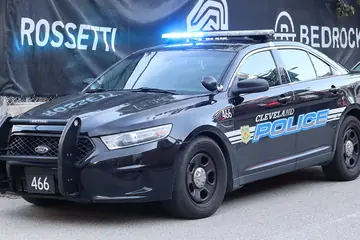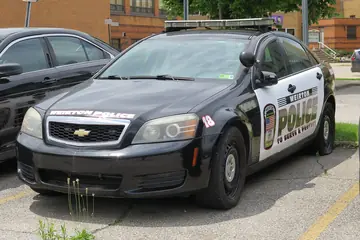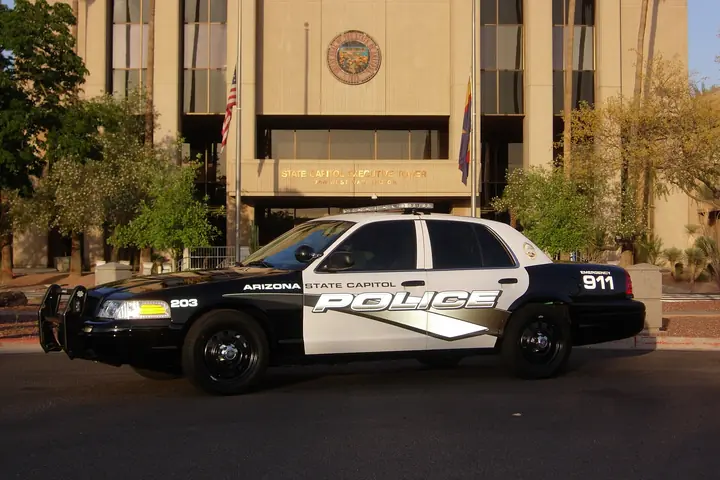
What the Crown Victoria Police Interceptor is, and why it is out of production
The Ford Crown Victoria Police Interceptor is the police-specification version of the full-size Ford Crown Victoria sedan: a rear-wheel-drive, body-on-frame (a separate steel frame carrying the body, as on a truck) four-door with a 4.6-liter V8. Officers, collectors and auction buyers know it as the CVPI, the Crown Vic or, after its Ford sales code, the P71. It rode on the Panther platform, the same body-on-frame architecture that underpinned the Mercury Grand Marquis and Lincoln Town Car.
The verdict on this page is out of production, and it is not a close call. Ford stopped accepting Police Interceptor orders in April 2011, built the final Police Interceptor in August 2011 for the Kansas Highway Patrol, and closed Crown Victoria production at St. Thomas Assembly in Ontario on Sept. 15, 2011. Every CVPI on the road today is therefore a 2011 model or older, and every one that changes hands is a used, ex-fleet or privately held car.
Ford had already ended sales of the Crown Victoria to the general public in 2008, keeping the car alive for police and fleet customers until its two replacements, the Taurus-based Police Interceptor Sedan and the Explorer-based Police Interceptor Utility, went on sale in 2012.
How the Police Interceptor differed from a civilian Crown Victoria
The Police Interceptor shared its body and platform with the retail Crown Victoria, but it was not a civilian car with lights added. Michigan State Police (MSP) published the final specification in its model year 2011 test book, which describes the car under sales code P71 with these police-relevant details:
- Engine: 281 cu in (4.6L) V8, sequential multiport fuel injection, E85 capable (able to run on fuel containing up to 85% ethanol), dual exhaust, 250 hp at 5,000 rpm and 297 lb-ft at 4,000 rpm.
- Driveline: 4R70W four-speed automatic with a 3.27 or 3.55 rear axle ratio.
- Electrical: a 200-amp alternator to feed radios, lights and computers.
- Chassis: independent short-long-arm front suspension, a four-bar-link rear axle with a Watts linkage, and Goodyear Eagle RS-A P235/55R17 tires rated to the W speed category.
- Dimensions: 114.6-inch wheelbase, 212.0-inch length, 19.0-gallon fuel tank, 20.6 cubic feet of trunk space and a 4,184-pound test weight.
Output of the 4.6L rose over the car's life. Wikipedia lists 215 hp for 1998-2000, 235 hp for 2001-2002, 239 hp for 2003 and 250 hp from 2004 through 2011. A retired sergeant writing for Police1 adds the practitioner view of why agencies liked the package: body-on-frame durability, a rear-drive V8, upgraded suspension and brakes, a police engine calibration, an external engine oil cooler, a roomy interior and straightforward maintenance.
From 1999 Ford also offered a Street Appearance Package (SAP), which gave the Police Interceptor chrome trim and Crown Victoria badging so it resembled the civilian P73 model. That option matters to anyone trying to identify a car today, because chrome trim alone does not prove a Crown Victoria was never a police vehicle.
Performance: what Michigan State Police testing showed
MSP publishes an annual police vehicle evaluation with acceleration, top-speed and braking data for each model. Its figures are clean-roof test results: the cars run without lightbars, spotlights or other equipment, so a fully equipped patrol car is slower.
In MSP's model year 2011 tests (published November 2010, the Crown Victoria's final model year), the Police Interceptor with the 3.27 axle reached 60 mph in 9.01 seconds and 100 mph in 24.40 seconds, covered the quarter mile in 16.82 seconds at 85.78 mph and reached a top speed of 129 mph. With the 3.55 axle it ran 0-60 mph in 8.87 seconds and 0-100 mph in 24.37 seconds, with a 119 mph top speed.
Those numbers put the CVPI behind every V8 rival in the same book. The Chevrolet Caprice 9C1 6.0L ran 0-60 mph in 6.18 seconds with a 148 mph top speed; the Dodge Charger 5.7L ran 6.24 seconds and 146 mph. Even the V6 Chevrolet Impala 9C1 (8.78 seconds, 138 mph) and the Chevrolet Tahoe PPV SUV (8.70 seconds, 139 mph) reached 60 mph sooner. The gap to the Caprice and Charger was roughly 2.8 seconds to 60 mph and 17 to 19 mph in top speed.
Two comparisons put the result in context. First, MSP's current purchasing criteria call for 0-60 mph in 9.0 seconds and 0-100 mph in 24.6 seconds; the 3.27-axle CVPI's 2011 figures sit just over the first and just under the second. MSP's criteria in 2010 may have differed, so this is a comparison with today's standard, not a statement that the car failed a test. Second, the same agency's 1987 test of the pre-Police Interceptor Crown Victoria 302 recorded 11.85 seconds to 60 mph and 109.2 mph, against a 1987 bid qualification of 12.9 seconds to 60 mph. The full 2011 data are in the MSP 2011 Model Year Police Vehicle Evaluation Program, hosted by the National Institute of Justice.
History: from the LTD Crown Victoria to the last car of 2011
Ford introduced a police-package LTD Crown Victoria in 1983. According to Ford's own history, it "debuted the dedicated Police Interceptor" in 1992 with a 4.6-liter V8. Police1 gives a different milestone, saying Ford "officially began using the name Crown Victoria Police Interceptor" in 1999. Both statements are printed here because the sources do not agree on when the name, as opposed to the dedicated model, began.
The P71 code has a similar dispute. Wikipedia says P71 was used from 1992 to 2009 and replaced by P7B in 2010, and earlier police Crown Victorias used other codes, such as P72. Yet MSP's model year 2011 test book, printed in November 2010, still lists the Police Interceptor under sales code P71. Many enthusiast sources also date P71 to 1998 rather than 1992. This page does not state a P7B start year as fact.
The ending is better documented. Ford announced the replacement in 2009 and said the new Interceptor would be offered "without interruption" when the Crown Victoria was discontinued. Police departments bought ahead of the deadline: AutoGuide reported that Crown Victoria sales rose 64% through July 2011, to 35,203 units. The last Police Interceptor went to the Kansas Highway Patrol in August 2011. The very last Crown Victoria, built Sept. 15, 2011, was an export car for Saudi Arabia, not a police car. Ford says the replacement sedan and utility went on sale in 2012, built at Chicago Assembly, and that the 100,000th new-generation Police Interceptor was sold in 2015.
Market dominance, and why agencies moved on
The CVPI's share of the police market is often quoted as a single number. The sources actually give four different figures, measuring different things in different years:
- Ford says the Crown Victoria accounted for 85% of police pursuit vehicle sales in the U.S. and Canada by 1998.
- Wikipedia, citing the Gainesville Sun of May 2003, says the CVPI made up about 85% of police cars in use in the U.S.
- Ford, as reported by the Associated Press in 2009, said it sold about 75% of all U.S. police vehicles, about 45,000 a year.
- AutoGuide put the CVPI at about 70% of the police market in August 2011.
The car's position strengthened after Chevrolet discontinued the police Caprice in 1996, removing a direct full-size, rear-drive competitor. AutoGuide described it as the top law-enforcement choice from 1996 to 2010.
The end came from regulation and from competition. AutoGuide attributed the retirement to federal fuel-economy targets; the car's EPA rating in its final year was 14 mpg city, 21 highway and 17 combined. By 2011 the performance gap shown in MSP testing was also wide. Agency fleet records show the transition: Seattle's city auditor reported that the police department selected the Police Interceptor Utility in 2013 after the Crown Victoria's retirement and had 272 of them in its patrol fleet at year-end 2020, while a chart in the same audit labels the year-end 2012 fleet as 268 Crown Victorias.
Fuel-tank fires, intake manifolds and other documented issues
The CVPI's best-known controversy concerned fuel-fed fires after high-energy rear impacts. The National Highway Traffic Safety Administration (NHTSA) Office of Defects Investigation reviewed post-rear-crash fires in 1992-2001 Panther-platform vehicles under review SQ01-014. Law enforcement submissions described 17 such CVPI fires between 1983 and 2001, with 11 alleged deaths. NHTSA closed the review on Oct. 3, 2002, finding the vehicles "are not over-represented with respect to the risk of fire," and denied a Center for Auto Safety petition to expand it. The decision is published in the Federal Register of Dec. 4, 2002.
Ford nevertheless acted. Technical Service Bulletin (TSB, a manufacturer repair instruction to dealers) 01-21-14 suggested modifications to reduce fuel-tank punctures after rear crashes on 1992-2001 Panther cars. Wikipedia, citing I-CAR, adds that from 2005 Ford offered optional trunk packs, about $150 per car at the time, to keep cargo from puncturing the tank, and an optional automatic fire suppression system.
The second documented problem is mechanical. 1996-2001 Ford, Lincoln and Mercury 4.6L two-valve engines used a plastic (composite) intake manifold that could crack and leak coolant. Ford issued TSBs 97M91, 99M01 and 01M02, and a class-action settlement covering about 1.8 million owners produced reimbursement of at least $735 per replaced manifold and a seven-year warranty extension. FordMuscle quotes a 1999 Ford notice saying manifolds had been replaced free for police and taxi fleets, although that notice does not name the Crown Victoria. A revised manifold with a bolt-on aluminum thermostat housing arrived for 2003; Wikipedia says it too was prone to problems, particularly its plastic rear heater hose nipple.
Buying a retired Crown Victoria Police Interceptor: what to check
Ford never sold the CVPI new to the public, but decommissioned cars were widely available, and taxi companies and other buyers wanting durability or a large back seat bought them. No primary or data source located for this page measures current auction demand or prices, so none is asserted here. What the research does support is a short list of structural checks.
- Age: the newest CVPI is a 2011 model. It predates the crash-avoidance technology now common on police vehicles, and its EPA combined rating is 17 mpg. For a buyer who needs modern safety equipment or low fuel cost, it is a poor choice regardless of condition.
- Idle hours: patrol cars idle for long periods, and that wear does not show on the odometer. One town fleet policy treats an hour of idling as roughly equal to 33 miles of driving, an approximation rather than a measured figure. A Santa Barbara County cost study, built on Crown Victoria-era fuel rates, assumed three idle hours per shift.
- Mileage at retirement: replacement thresholds vary by agency. Newport Beach, California, for example, schedules police patrol vehicles for replacement at 75,000 miles or four years.
- Intake manifold and cooling: look for coolant leaks at the manifold on 1996-2001 cars and at the rear heater hose connection on 2003 and later cars, and ask whether the manifold was replaced under Ford's programs.
- Fuel-tank protection: on 2005 and later cars, check whether a trunk pack or fire suppression system was fitted.
- Decommissioning: some states set rules for what must come off before sale. Texas law, for example, bars state agencies from selling a marked patrol car to the public until lights, sirens, spotlights, emblems and the outline of an emblem are removed.
Frequently asked questions
What does P71 mean on a Crown Vic?
P71 is Ford's sales code for the Crown Victoria Police Interceptor. Michigan State Police's model year 2011 test book lists the Ford Police Interceptor under sales code P71. Wikipedia says a P7B code replaced P71 in 2010, which conflicts with that test book, and earlier police Crown Victorias used other codes such as P72. The code identifies the police model, but sources disagree on its exact years.
What years was the Crown Victoria Police Interceptor made?
Ford says it debuted the dedicated Police Interceptor in 1992, and the last one was built in August 2011 for the Kansas Highway Patrol. A police-package LTD Crown Victoria existed from 1983. Police1 says Ford began officially using the name Crown Victoria Police Interceptor in 1999, so the naming date depends on the source.
How fast is a P71 Crown Vic?
In Michigan State Police model year 2011 testing, the Police Interceptor with the 3.27 axle reached 60 mph in 9.01 seconds and a 129 mph top speed. With the 3.55 axle it ran 8.87 seconds and 119 mph. These are clean-roof figures, taken without lightbars or equipment, so an equipped patrol car is slower.
Why did Ford stop making the Crown Victoria Police Interceptor?
Ford ended Crown Victoria production at St. Thomas, Ontario, in 2011 and replaced the car with two new models. AutoGuide attributed the decision to federal fuel-economy targets; the final CVPI was rated 14 mpg city by the EPA. By then it also trailed newer police cars badly in Michigan State Police acceleration and top-speed testing.
What replaced the Crown Vic police car?
The Taurus-based Ford Police Interceptor Sedan and the Explorer-based Ford Police Interceptor Utility replaced it, both on sale in 2012 and built at Chicago Assembly. Ford says the Utility went on to become America's best-selling police vehicle, while the sedan was discontinued in 2019. Both successors used V6 engines rather than the Crown Victoria's V8.
Were Crown Vic police cars prone to fires?
NHTSA closed its review in 2002, finding 1992-2001 Panther-platform cars were not over-represented in fire risk. Law enforcement had reported 17 CVPI post-rear-crash fires with 11 alleged deaths. Ford issued TSB 01-21-14 with suggested modifications, and from 2005 offered optional trunk packs and an automatic fire suppression system.
What should I check on a used Crown Victoria Police Interceptor?
Check the intake manifold and cooling system first, then idle hours and fuel-tank protection. 1996-2001 4.6L engines used a plastic manifold that could crack and leak coolant, and the 2003 revision had a weak plastic heater hose nipple. Patrol idling adds wear the odometer does not show, and 2005 and later cars may have trunk packs fitted.
Sources
- Michigan State Police; hosted by National Institute of Justice (NCJRS) — 2011 Model Year Police Vehicle Evaluation Program
- Seattle Office of City Auditor — Audit of Seattle Police Department Patrol Vehicle Procurement
- govinfo.gov/content/pkg/FR-2002-12-04/html/02-30735.htm
- at.ford.com/us/en/home/news-media/news/2025/1/tbt-01-09-2025.html
- police1.com/patrol-vehicle/the-crown-victoria-how-fords-police-interceptor-b…
- autoguide.com/auto-news/2011/08/ford-crown-victoria-being-hoarded-by-police-…
- fordmuscle.com/news/ford-settles-manifold-lawsuit