What police vehicle safety covers
Police vehicle safety is the study and prevention of deaths and injuries to law enforcement officers in and around their vehicles: crashes while driving, crashes on motorcycles, and officers struck by passing traffic while outside the car. It also covers how the vehicles themselves are engineered and equipped, because a patrol car is both a workplace and a piece of protective equipment.
The scale is larger than most readers expect. The National Institute for Occupational Safety and Health (NIOSH, the federal research agency for workplace safety) reports that from 2014 to 2023, excluding COVID-19 deaths, "496 officers died due to motor vehicle related incidents," or 29% of line-of-duty deaths. Of those, 342 died in vehicle crashes (20% of 1,716 total deaths) and 154 were struck by vehicles (9%). That is about 50 deaths a year, or roughly one a week. NIOSH draws these counts from the National Law Enforcement Officers Memorial Fund (NLEOMF), the nonprofit that tracks officer line-of-duty deaths.
The most recent year is lower. NLEOMF counted 34 traffic-related officer deaths in 2025, down 23% from 44 in 2024: 11 automobile crashes, three single-vehicle crashes, seven motorcycle crashes and 13 officers struck outside their vehicles. NLEOMF's year-end figures are preliminary and can be revised as cases are confirmed.
Seat belts: the persistent gap
NIOSH lists "Not wearing a seat belt" among the behavior-related hazards officers face, and the data explain why. NLEOMF found that from 2015 to 2019, 47% of officers involved in fatal vehicle crashes were not wearing a seat belt, rising to 52% in single-vehicle crashes. That analysis rests on 142 crashes in which belt use was verified.
The longer history comes from a National Highway Traffic Safety Administration (NHTSA) study of federal crash data from 1980 to 2008. NHTSA counted 823 officers killed in motor vehicle crashes in that period, 733 in passenger vehicles and 90 on motorcycles; officers struck by vehicles were excluded from that count. Only 44.7% of the officers killed in passenger vehicles (328 of 733) were using restraints. Restraint use rose to 56% in the 1990s and was 50% in the 2000s, with 42% unrestrained. On motorcycles, 91.1% of officers killed wore helmets.
Officers were not less careful than the public. From 2000 to 2008, killed officers used restraints more often than non-officer passenger-vehicle occupants who were killed (40% restrained, 52% not). The gap is between officers and the near-universal belt use the job's crash exposure would justify. Partial-year data show the issue persists: through the third quarter of 2024, NLEOMF and NHTSA recorded 39 traffic-related officer deaths, five involving pursuits and three with officers confirmed not wearing seat belts.
When and how fatal crashes happen
The NHTSA study describes a consistent pattern. Officer passenger-vehicle crash deaths occurred mostly during dark hours, between 8 p.m. and 4:59 a.m., peaking from 11 p.m. to 1:59 a.m. Among collisions with other moving vehicles, angle crashes accounted for 55%, head-on crashes 27%, rear-end crashes 13% and sideswipes 5%.
The National Institute of Justice (NIJ, the research arm of the U.S. Department of Justice) reported that from 2007 to 2016, motor vehicle crashes, including officers struck by vehicles, were the leading cause of officer line-of-duty deaths. Motor-vehicle-related deaths numbered 50 (37% of the total) in 2014, 49 (35%) in 2015 and 54 (38%) in 2016.
NHTSA's 1980-2008 restraint and timing figures are historical. For current seat belt data, the NLEOMF 2015-2019 analysis is the more recent reference. The full federal study is published as NHTSA report DOT HS 811 411.
Struck-by deaths: the risk outside the car
Crash counts alone understate the danger. Officers killed while standing beside a stopped vehicle, directing traffic or working a crash scene are recorded separately as struck-by deaths. NIOSH counts 154 such deaths from 2014 to 2023, nearly a third of all motor-vehicle-related officer deaths in that decade. In NLEOMF's preliminary 2025 count, 13 of the 34 traffic-related deaths were officers struck outside their vehicles, the single largest category that year.
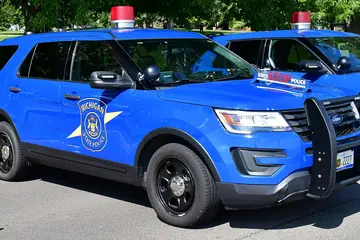
Vehicle makers have responded with equipment rather than claims of a solution. Ford lists a "police perimeter alert" as standard on the model year 2026 Police Interceptor Utility, alongside other police-specific features. The research behind this page did not include any study measuring how much such systems reduce struck-by deaths, so no effect is claimed here.
How police vehicles are engineered for crashes
The defining engineering standard for a police vehicle is high-speed rear impact, because a patrol car parked on a highway shoulder is exposed to being hit from behind at traffic speed. Ford states that "The Police Interceptor Utility is 75-mph rear-impact crash tested," against the 30-mph rear test in the federal fuel-system standard. Ford also notes that the full-size spare tire in its factory location "is necessary to achieve police-rated 75-mph rear-impact crash-test performance." An upfitter or later owner who relocates that spare changes the vehicle's tested configuration.
Other occupant protection on the current Police Interceptor Utility includes steel intrusion plates in the front seat backs, available ballistic front-door panels rated to National Institute of Justice Level III+ or IV+, and optional automatic emergency braking with a temporary disable switch for law enforcement use. Ballistic panels are an option, not standard equipment.
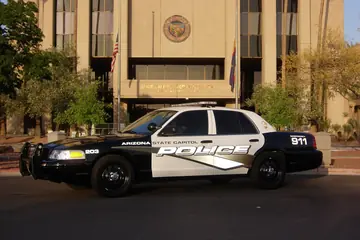
The Crown Victoria fuel-tank fires
The 75-mph standard has a history. NHTSA opened investigation SQ01-014 after Ford issued a technical service bulletin suggesting modifications "aimed at reducing the potential for post-rear crash fuel tank punctures" on the Crown Victoria Police Interceptor (CVPI). NHTSA received summaries of 17 incidents alleging post-rear-crash fires in CVPIs between 1983 and 2001, with allegations of 11 deaths, four of them in 2001.
NHTSA's analysis of fatal crash data found the vehicles "not over-represented with respect to the risk of fire": a fire risk of 0.033 for Ford's Panther platform against 0.033 for other sedans including police vehicles, and 0.029 against 0.033 with police vehicles excluded. The agency closed the investigation on October 3, 2002 and denied a petition to upgrade it, as recorded in the Federal Register notice of December 4, 2002. Ford stated that the car met the 30-mph federal fuel-system standard and did not leak in a 50-mph test.
Ford made changes anyway. On September 30, 2002, Ford and the Arizona Attorney General, Janet Napolitano, announced the results of a nine-member Blue Ribbon Panel and Technical Task Force whose work included two 75-mph crash tests. The measures included shields for rear axle components, differential bolts and tank straps; an optional trunk package to carry equipment flat with a puncture-resistant layer; a trunk-mounting template for upfitters; and a commitment that "Ford will provide upgrades to all Police Interceptors currently in police service at no cost." Ford engineers later developed an impact-sensed fire suppression system that discharges a water-based foam. Its first complete extinguishment of a forced-ignition fire after a 75-mph crash came in March 2004; a 75-mph impact carries about six times the energy of the 30-mph federal test. The Ford and Aerojet paper expected production from 2005 and stated the system could not be retrofitted to earlier cars. Whether it reached meaningful sales volumes was not confirmed.
The Police Interceptor Utility exhaust investigation
The second major investigation concerned exhaust odor in the Ford Explorer and its police version. NHTSA opened Engineering Analysis EA17-002 on July 27, 2017, upgrading a preliminary evaluation opened in July 2016. It covered model year 2011 to 2017 Explorers "including Police Interceptor," an estimated 1,333,000 vehicles. At opening, NHTSA counted 2,719 reports after removing duplicates, three crashes or fires, 39 alleged injuries and no fatalities.
NHTSA stated at the time that "no substantive data or actual evidence (such as a carboxyhemoglobin measurement)" supported a claim that any injury or crash resulted from carbon monoxide poisoning, although preliminary testing suggested CO "may be elevated in certain driving scenarios." It also found that the Police Interceptor version was "experiencing exhaust manifold cracks" that could explain the odor.
The investigation closed on January 17, 2023 without a recall, after NHTSA reviewed more than 6,500 consumer complaints. According to the closing summary, "Sealing issues caused by upfitting were responsible for the highest measured carbon monoxide levels." With Ford's police field service action (17B25) performed, which addresses upfit sealing at no cost to agencies, occupant-compartment CO stayed below environmental limits, and NHTSA did not identify a defect presenting an unreasonable risk to safety. These closing details come from secondary reproductions of NHTSA's summary (CarComplaints.com and Ford Authority); NHTSA's own closing document was not retrieved for this page.
What reduces the risk
Both investigations point to the same lesson: aftermarket installation is a safety factor. The Crown Victoria response included a trunk-mounting template so that equipment would not puncture the tank, and the Explorer probe attributed the highest carbon monoxide readings to upfit sealing. How a car is equipped after delivery matters as much as how it left the factory.
Agency programs also show measurable results. NIJ reported that after a comprehensive vehicle-safety overhaul, the Las Vegas Metropolitan Police Department recorded statistically significant decreases in crash and injury rates (preliminary findings), had no line-of-duty crash deaths three years later, and estimated $1.1 million in savings. Two comparison agencies without similar programs saw no substantial change. Seat belt use in Las Vegas also improved, though NIJ gave no percentage.
Common misconceptions
- "NHTSA found that police Explorers poisoned officers with carbon monoxide." NHTSA closed EA17-002 without a recall, attributed the highest CO levels to upfit sealing and found no unreasonable-risk defect.
- "NHTSA found the Crown Victoria was a fire trap." NHTSA's 2002 analysis found no over-representation in fire risk; Ford added shields, a trunk pack and later an optional fire suppression system.
- "Most officers killed in crashes were belted." Nearly half (47%) of officers in fatal crashes from 2015 to 2019 were not.
- "Crashes are the whole story." Struck-by deaths are a separate, large category: 154 of 496 motor-vehicle-related deaths from 2014 to 2023.
Frequently asked questions
How many police officers die in car crashes each year?
About 50 officers a year died in motor-vehicle-related incidents from 2014 to 2023, according to NIOSH, counting both crashes and officers struck by vehicles. That is roughly one a week. NLEOMF's preliminary count for 2025 was lower: 34 traffic-related deaths, including 13 officers struck outside their vehicles and seven motorcycle crashes.
Do police officers wear seat belts?
Not consistently. NLEOMF found that 47% of officers involved in fatal vehicle crashes from 2015 to 2019 were not wearing a seat belt, rising to 52% in single-vehicle crashes. An older NHTSA study of 1980-2008 data found 44.7% of officers killed in passenger vehicles were restrained. NIOSH lists not wearing a seat belt as a key hazard.
Did Ford Explorer police cars have a carbon monoxide problem?
NHTSA investigated and closed the case in January 2023 without a recall. Its probe covered model year 2011-2017 Explorers, including Police Interceptors, and found that sealing issues caused by upfitting produced the highest carbon monoxide readings. Ford's field service action 17B25 addressed upfit sealing at no cost to agencies, and NHTSA identified no unreasonable-risk defect.
Why did Crown Victoria police cars catch fire?
High-speed rear impacts could puncture the fuel tank, leading to fires in some crashes. NHTSA reviewed 17 alleged incidents but found the car was not over-represented in fire risk. Ford nonetheless added shields, a protective trunk package and an upfit template in 2002, and later developed an optional fire suppression system.
What crash test are police cars built for?
Ford engineers the Police Interceptor Utility for a 75-mph rear-impact crash test, far above the 30-mph rear test in the federal fuel-system standard. A 75-mph impact carries about six times the energy of the 30-mph test. Ford says the full-size spare must stay in its factory location to achieve that performance.
What is a struck-by death?
A struck-by death is an officer killed by a vehicle while outside his or her own car, for example during a traffic stop or at a crash scene. NIOSH counted 154 struck-by deaths from 2014 to 2023, and in NLEOMF's preliminary 2025 figures they were the largest single category of traffic-related officer deaths.
Sources
- National Law Enforcement Officers Memorial Fund — 2025 End-of-Year Law Enforcement Officers Fatalities Report
- National Law Enforcement Officers Memorial Fund — Traffic-Related Fatalities Involving Law Enforcement Officers: 2015-2019 Use of Seat Belts in Fata…
- cdc.gov/niosh/motor-vehicle/law-enforcement/
- crashstats.nhtsa.dot.gov/Api/Public/ViewPublication/811411
- ojp.gov/pdffiles1/nij/252032.pdf
- static.nhtsa.gov/odi/inv/2017/INOA-EA17002-5925.PDF
- govinfo.gov/content/pkg/FR-2002-12-04/html/02-30735.htm
- nist.gov/document/r0501598pdf
- policeinterceptor.com/pdf/2023%20Ford%20Police%20brochure.pdf
- fordauthority.com/2023/01/nhtsa-closes-ford-explorer-exhaust-odor-investigat…