The short answer
There is no single price for a police car: the cost depends on the agency, the model year, the contract it buys through and, above all, the upfit. In one audited example, the Seattle Police Department paid about $86,836 for each 2020 Ford Police Interceptor Utility, of which $38,482 (about 44%) was the base vehicle and $48,354 (about 56%) was upfitting and additional manufacturer options, according to the Seattle Office of City Auditor's January 2022 audit.
Upfitting means the lights, partition, consoles, radios, computers and wiring an agency adds after the vehicle is delivered. Seattle's auditors put it simply: "The base vehicle is not equipped with the features" a patrol car needs, such as radios. In Seattle's 2020 case, that added equipment and labor cost more than the vehicle itself.
Every figure on this page is a dated figure from a named agency's own documents. None is a current price, and no federal source reviewed for this page publishes a national average cost for a police car.
What goes into an upfit
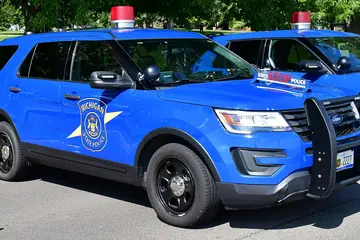
An upfit turns a police-package vehicle into a working patrol car. Seattle's audit describes items "like the red/white/blue lightbar on the top of the vehicle, and the hard-plastic rear seats for transporting people in custody." Most individual upfit parts in Seattle's build cost under $300 each; nine items cost over $1,000.
Across the agency records reviewed, a typical patrol upfit draws from the same list:
- Warning equipment: light bars, grille and interior lights, sirens and speakers, and spot lamps.
- Prisoner containment: protection barriers (partitions between the front and rear seats) and washable hard-plastic rear seats.
- Protection and mounting: push bumpers, locking gun mounts or racks, consoles and control heads, and often ballistic door panels.
- Information technology: radios, in-car video, laptops and mounts, routers and modems, printers and keyboards.
- Markings: decals and agency graphics.
Builds also vary by role. In Seattle, 83% of PIUs are standard patrol builds; the rest are canine, special operations, investigations, sergeant and watch commander vehicles, which differ in lighting, back seat and decals. Peer agencies differ too: all five that Seattle's auditors surveyed install a locking gun mount and push bumper, most install ballistic door panels and spot lamps, and half install a dual-drawer cargo system.
Some police content comes from the factory instead. Manufacturer options such as wiring harness kits, inoperable rear doors and ballistic panels are priced on the vehicle order, while aftermarket equipment and labor come from upfitters and in-house staff. Ford's 2023 police guide lists pre-wiring packages for grille lights, siren and speaker for this reason.
One audited example: Seattle's 2020 Police Interceptor Utility
Seattle's audit is unusually detailed because it itemizes who was paid for the $48,354 upfit on each 2020 PIU:
- Systems for Public Safety, an upfitter in Lakewood, Washington: $22,067.
- In-house city work: $18,178, made up of about $12,114 in Seattle IT parts and labor and $6,064 from the Finance and Administrative Services department.
- Ford, for additional manufacturer options: $8,109.
About 60% of the upfit was outsourced. Seattle IT's share covered radio, in-car video, laptop and mount, router and modem, printer and keyboard. That category is easy to miss: the auditors noted that one of the city's own cost charts understated vehicle cost because it left IT installation out.
Seattle's 2020 figures also include the hybrid premium. Hybrid PIUs cost "about $11,000 more per base vehicle than the gasoline model," and the inflation-adjusted average PIU purchase cost rose from $56,303 for model year 2015 to $73,719 for the model year 2020 hybrid, excluding IT upfit.
How much agencies' costs vary
Seattle's auditors surveyed five peer agencies, King County and Spokane in Washington, Portland in Oregon, and Sacramento and San Jose in California, on their 2020 PIU costs:
- Base vehicle: median $47,600, range $41,200 to $50,186.
- Upfitting: median $17,620, range $8,528 to $34,543.
- Total: median $65,262, range $55,449 to $84,729.
Seattle had the lowest base price of the group and the highest upfit, and the auditors did not determine why. The spread is the point. Five agencies buying the same model in the same year reported totals almost $30,000 apart, and upfit costs that differed by a factor of four. One agency's figure is not a national figure.
What recent agency records show
Council and county records give dated figures for later model years. Each is that agency's figure in that year, under that contract, and is useful for its structure rather than as a price to expect elsewhere.
- Novi, Michigan, November 17, 2025: the City Council considered six 2026 PIU Hybrids through the MiDeal cooperative program at $45,441 (patrol) or $45,511 (traffic) per vehicle, plus $26,193.74 per vehicle for upfits and $1,649.99 for decals, about $73,285 to $73,355 per unit and $439,848.38 in total. The base quote of $44,991 included small factory options: a police wire harness connector kit ($200), inoperable rear door handles and windows ($80) and single-key locks ($50). The packet's purchase history lists different figures, $45,541 for the vehicle and $27,767 for the upfit; both appear in the council packet.
- Fort Bend County, Texas, Constable, October 2, 2025 quote: a 2025 PIU 3.3L V6 through TIPS contract 240901 at a $47,395 base price, $1,995 in published factory options less a 5% discount, and $13,253 in "unpublished options" covering grille lights, siren and speaker wiring, police tail-lamp housings, an OBD-II splitter, upfitter installation and a pre-built unit, for a total of $62,543.25.
- Des Moines, Iowa, March 18, 2024: $252,637.16 for emergency equipment for 12 new Police Interceptors, covering light bars and sirens, protection barriers, washable rear seats, aluminum push bumpers, computers and control consoles, bought from Keltek Inc. and Whelen under State of Iowa contracts and a NASPO ValuePoint master agreement. Dividing by 12 gives about $21,053 per vehicle; that is a calculation for this page, not a figure the city stated.
- Northwest Municipal Conference, Illinois: the Suburban Purchasing Cooperative's Contract #204 page, viewed October 29, 2026, listed a 2027 PIU at $44,954 with conventional gas and standard equipment, or $47,615 for the hybrid ("limited supply"), under a contract approved through October 26, 2026.
- South Carolina, price sheet dated November 1, 2020: the state contract listed a Ford PIU base price of $32,603, with delivery 120 days after receipt of order.
- Washington State Patrol, 2019-21 biennium: a 2020 legislative audit reported plans to spend $13.3 million to buy and equip 240 pursuit vehicles. Simple division gives roughly $55,400 per vehicle, an estimate the report itself does not state.
The South Carolina and Illinois figures show why contract prices should not be read as retail prices. The first is a 2020 base price for one state's contract; the second is a model year 2027 price for a regional cooperative. Neither includes the upfit.
How agencies buy police vehicles
Most agencies do not negotiate each purchase from scratch. They buy through cooperative or state contracts (purchasing agreements that one government awards and others may join, often called piggybacking). The records above show several: Michigan's MiDeal program, the TIPS cooperative in Texas, Iowa state contracts and NASPO ValuePoint, and the Illinois cooperative. Seattle used Washington State's bundled contract before 2018 and found that managing its own contract cost less.
Lead time is part of the cost. At the time of Seattle's audit, a new PIU took about 18 months from order to service: about eight months at the Ford dealer and about ten months in upfitting, roughly six months longer than normal because of supply-chain problems. Sacramento, which upfits in-house, reported no trouble getting vehicles ready during the same disruption.
The cost after purchase
Purchase price is only the start. Seattle paid about $2.9 million on PIU maintenance and repair in 2020, about $11,000 per vehicle; its preventive maintenance cost $1,391 per vehicle against a peer median of $1,999. The full figures are in the Seattle audit.
The hybrid decision shows the trade-off between purchase and running cost. In Seattle a hybrid PIU cost about $11,000 more per base vehicle. Against that, Ford estimated fuel savings of $3,500 to $5,700 per vehicle per year, and Seattle's fleet division set a seven-year replacement schedule for hybrid PIUs against five years for gasoline models. Ford's savings estimate is the manufacturer's projection, not a measured result.
Reuse lowers cost as well. Des Moines states that it reuses existing equipment "whenever possible" when outfitting new vehicles, and the Des Moines council communication lists the equipment it bought new.
Common mistakes about police car costs
- Quoting the base price as the cost of a police car. In Seattle's 2020 example the upfit exceeded the vehicle, and the peer median upfit was $17,620 on a $47,600 base.
- Treating one agency's figure as national. Five peer agencies reported 2020 totals from $55,449 to $84,729.
- Reading contract prices as retail prices. They are specific to a contract, a date and a model year.
- Leaving out IT and communications. Radios, computers, cameras and routers are often installed in-house and can be missing from a vehicle cost figure, as Seattle's own chart showed.
Frequently asked questions
How much does a police car cost?
It depends on the agency and the build. Seattle paid about $86,836 per 2020 Ford Police Interceptor Utility, according to a 2022 city audit, while five peer agencies' 2020 totals ranged from $55,449 to $84,729, with a median of $65,262. These are dated agency figures, not current prices, and no national average was found.
How much does it cost to upfit a police car?
Upfit costs vary widely by agency. Seattle paid $48,354 per 2020 PIU for upfitting and added options, five peer agencies ranged from $8,528 to $34,543 (median $17,620) that year, and Novi, Michigan's 2025 council packet listed $26,193.74 per 2026 PIU Hybrid plus $1,649.99 for decals.
What equipment goes into a police car?
A patrol upfit typically includes light bars, sirens and speakers, prisoner partitions, hard rear seats, push bumpers, locking gun mounts, consoles, computers and mounts, radios, in-car video, routers and modems, spot lamps and often ballistic door panels, according to Seattle's 2022 audit and a 2024 Des Moines council communication.
Why are police cars so expensive?
Upfitting can equal or exceed the price of the vehicle. In Seattle's 2020 example, upfitting and added options were about 56% of the $86,836 total. Equipment, upfitter labor and in-house IT installation for radios, video and computers all add to the base price.
How long does it take to get a new police car?
Seattle reported about 18 months from order to service at the time of its 2022 audit: about eight months at the Ford dealer and about ten months in upfitting. The auditors said that was roughly six months longer than normal because of supply-chain problems.
Do hybrid police cars cost more?
Yes, in Seattle's case a hybrid Police Interceptor Utility cost about $11,000 more per base vehicle than the gasoline model. Ford estimated fuel savings of $3,500 to $5,700 per vehicle per year, and Seattle scheduled hybrids for replacement after seven years instead of five.
Sources
- Seattle Office of City Auditor — Audit of Seattle Police Department Patrol Vehicle Procurement
- Washington State JLARC — Washington State Patrol Pursuit Vehicle Replacement (Report 20-05)
- cityofnovi.org/media/qombqpz1/251117matter2.pdf
- councildocs.dsm.city/communications/2024/24-102.pdf
- agendalink.fortbendcountytx.gov/docs/2025/CCTR/20251106_4044/66001%5FVehicle…
- nwmc-cog.org/suburban-purchasing-cooperative/police-pursuit-vehicles/contrac…
- procurement.sc.gov/files/attach/LE%209%20Base%20Price%203.pdf
- policeinterceptor.com/pdf/2023%20Ford%20Police%20brochure.pdf