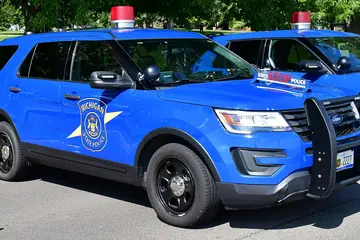
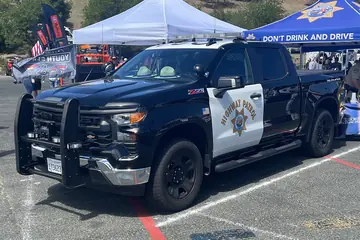
What an unmarked police car is
An unmarked police car is a police car, meaning a vehicle operated by a law enforcement agency for police work, that lacks exterior markings and easily visible or roof-mounted emergency lights. In Wikipedia's wording, "An unmarked car is a police car that lacks markings and easily visible or roof-mounted emergency lights." It still carries police equipment, often with emergency lights embedded in the grille, windows or interior, or mounted so they retract out of sight.
Three related terms are often confused, and the differences matter:
- Unmarked car: a police vehicle with concealed police equipment and no obvious markings.
- Undercover car: a vehicle that lacks police markings and equipment entirely; Wikipedia describes such cars as "essentially civilian vehicles used by law enforcement."
- Ghost car: "A ghost car, also called a stealth car or semi-marked car," combines both approaches, with markings applied in colors similar to the body paint.
A fourth term, slick-top, is common among enthusiasts for a marked car with no roof light bar. No authoritative definition was found for it. Wikipedia notes only that "Some cars can be visibly marked but not fitted with audio or visual warning devices."
The stated public-policy concern with unmarked cars is impersonation. Wikipedia records that "The close resemblance of unmarked cars to civilian cars has created concerns of police impersonation," and that concern runs through the state statutes discussed below.
How manufacturers support low-profile builds
Police-package vehicles are built with unmarked use in mind. Ford offers exterior police badging delete and full-face wheel covers on its police vehicles "to create a stealth-like appearance for administrative, detective and investigative ops." Without the badges and with covered steel wheels, a Police Interceptor Utility looks much closer to a civilian Ford Explorer.
Ford lists "police dark car" among the standard police features of the model year 2026 Police Interceptor Utility. The sources reviewed for this page do not define the feature, so its exact function is not described here. General Motors lists "Surveillance mode calibration" and "Head and taillamp flasher calibration" among the model year 2026 Chevrolet Silverado PPV's highlights in the Michigan State Police test book.
Agencies also build the same model differently by role. Seattle's 2022 audit describes Police Interceptor Utilities built for patrol, canine, special operations, investigations and supervisors, with differences in lighting packages and decals. An investigations car and a patrol car can share a model and a model year yet leave the upfitter (the shop that installs lights, radios and other police equipment) looking quite different.
What vehicles agencies use as unmarked cars
Two kinds of vehicles serve as unmarked units: police-package vehicles with badging removed, and ordinary civilian models. The second group is larger than many readers assume. A January 2025 equipment memo from the Hawthorne, California Police Department listed five unmarked units due for replacement:
- 2017 Honda Pilot, 124,206 miles
- 2017 Toyota Sienna, 141,627 miles
- 2019 Nissan Maxima, 112,932 miles
- 2019 Dodge Ram 1500, 105,166 miles
- 2021 Toyota Highlander, 93,016 miles
None is a police-package vehicle. The memo adds that idle hours on these drivetrains were "even higher due to surveillance duties," because a car used for surveillance spends long periods parked with the engine running.
National counts do not separate unmarked cars cleanly. The Bureau of Justice Statistics estimated that U.S. local police departments operated 343,758 four-wheel motorized vehicles in 2013, including 220,779 marked vehicles. The remainder is not a count of unmarked police cars; it includes other vehicle types, and the survey's own categories should be consulted before any unmarked share is calculated.
State laws on unmarked cars in traffic enforcement
Some states restrict the use of unmarked cars for traffic enforcement. The three statutes below were confirmed for this page. They are examples, not a complete list: other states were not checked, and readers should not assume that a state not listed here has no rule. This page describes what the statutes say; it is not legal advice, and the current text should always be checked.
Ohio
Ohio Revised Code 4549.13 requires that a motor vehicle used by a state highway patrol member or other peace officer on duty "for the exclusive or main purpose of enforcing motor vehicle or traffic laws," where the offense is a misdemeanor, "shall be marked in some distinctive manner or color" and equipped with "at least one flashing, oscillating, or rotating colored light mounted outside on top of the vehicle." The companion section, R.C. 4549.14, makes an officer who arrests or helps arrest someone for such an offense while using a vehicle that does not meet 4549.13 "incompetent to testify as a witness in any prosecution" against that person. The rule is narrow: it applies to officers whose exclusive or main duty is traffic enforcement, and to misdemeanor offenses.
California
California Vehicle Code section 40800 requires an officer on duty for the exclusive or main purpose of enforcing the code's divisions on accidents and rules of the road to "wear a full distinctive uniform," and any vehicle used to be "a distinctive color specified by the commissioner." The section exempts officers whose main purpose is investigating vehicle theft, hit-and-run, speed contests or exhibitions, or felony matters, and warrant service when the officer is not patrolling highways. The section dates from 1959 and was last amended effective January 1, 2017. A related section, 40804, is believed to bar testimony when 40800 is not met, but its text was not verified for this page.
Georgia
O.C.G.A. section 40-8-91 requires vehicles used for traffic arrests to be "distinctly marked on each side and the back with the name of the agency responsible therefor" in letters at least four inches high, and sets a gray and blue scheme with "State Patrol" lettering for State Patrol vehicles. The same section provides that "An otherwise lawful arrest shall not be invalidated" by a failure to comply, and the annotated case State v. Carter held that arrests made from unmarked vehicles were not invalidated. The text above comes from Justia's unofficial reproduction; Justia shows an amendment effective July 1, 2026 whose content was not reviewed.
Proposals elsewhere
Arizona House Bill 2830 (2020) proposed that routine traffic enforcement use "appropriately marked" vehicles, capped "specially marked" vehicles at 10% of an agency's traffic fleet, and required uniforms for officers making traffic stops. Whether it was enacted was not verified.
Can an unmarked police car pull you over?
In general, the answer depends on the state, and the three statutes above show how differently states approach it. Ohio does not forbid the stop outright; it bars the traffic-duty officer in an unmarked car from testifying in a misdemeanor traffic prosecution. California requires a distinctive vehicle color and a full uniform for officers mainly engaged in traffic enforcement, with listed exceptions. Georgia requires markings but states that an otherwise lawful arrest is not invalidated if the vehicle lacks them.
The common belief that "unmarked cars can't pull you over" is therefore not accurate as a general statement. It is equally inaccurate to assume that unmarked traffic enforcement is unrestricted everywhere. The rules turn on the officer's main duty, the type of offense and the exact statutory text.
Unmarked cars in pursuits
Agency policy often limits what an unmarked car may do once a chase begins. The Los Angeles County Sheriff's Department Manual of Policy and Procedures directs that deputies in non-pursuit-rated or unmarked vehicles "shall terminate their involvement in a pursuit" when a marked unit with overhead lights joins, unless a supervisor directs otherwise. It adds that "Vehicles without red lights and siren shall not initiate or join in a pursuit under any circumstances."
Retired unmarked cars at auction
For a buyer, an ex-unmarked car has two features worth understanding. First, mileage can understate engine use. The Hawthorne memo's surveillance units carried idle hours higher than their mileage implied, and odometer readings of 93,016 to 141,627 miles were already substantial.
Second, markings may leave traces. Texas House Bill 473 (2015) bars state agencies from selling or transferring a marked patrol car to the public until police lights, sirens, spotlights, emblems and the "outline of an emblem" are removed. That last phrase reflects the reality of ghost graphics and faded decals: an emblem can leave a visible outline after the decal itself is gone.
Common misconceptions
- "Unmarked and undercover mean the same thing." An unmarked car carries concealed police equipment; an undercover car is essentially a civilian vehicle.
- "Unmarked cars can't make traffic stops." State rules vary; Georgia, for example, states that an otherwise lawful arrest is not invalidated by a lack of markings.
- "Ohio bans unmarked cars." Ohio's rule covers officers whose exclusive or main duty is traffic enforcement, and misdemeanor offenses.
- "Every unmarked car is a police-package vehicle." Hawthorne's unmarked fleet included a Honda Pilot, a Toyota Sienna and a Nissan Maxima.
Frequently asked questions
Can an unmarked police car pull you over?
It depends on state law. Ohio bars an officer on traffic duty in an unmarked car from testifying in a misdemeanor traffic prosecution. California requires a distinctive vehicle color and a full uniform for officers mainly enforcing traffic laws. Georgia requires markings but says an otherwise lawful arrest is not invalidated. Other states were not reviewed here.
What is a ghost police car?
A ghost car, also called a stealth car or semi-marked car, is a police vehicle whose markings are applied in colors close to the body paint. Wikipedia describes it as combining elements of marked and unmarked cars. Because the graphics blend with the paint, a ghost car can be harder to recognize at a glance than a conventionally marked unit.
What is the difference between unmarked and undercover police cars?
An unmarked police car keeps police equipment, such as hidden emergency lights, but lacks obvious markings. An undercover car lacks police markings and equipment entirely and is essentially a civilian vehicle used by law enforcement. Ghost or semi-marked cars are a third category with low-contrast markings.
What cars do police use as unmarked cars?
Agencies use both police-package vehicles with badging removed and ordinary civilian models. Ford offers a badging delete and full-face wheel covers for a stealth-like appearance. Hawthorne, California's unmarked units included a Honda Pilot, Toyota Sienna, Nissan Maxima, Ram 1500 and Toyota Highlander, according to a January 2025 department memo.
Does California allow unmarked cars for traffic enforcement?
California Vehicle Code section 40800 requires officers whose main duty is traffic enforcement to wear a full distinctive uniform and use a vehicle of a distinctive color. It exempts officers mainly investigating vehicle theft, hit-and-run, speed contests or felonies, and warrant service off the highways. Check the current statute text before relying on it.
Are there laws against unmarked police cars?
Some states restrict them for traffic enforcement rather than banning them. Ohio (R.C. 4549.13 and 4549.14), California (Vehicle Code 40800) and Georgia (O.C.G.A. 40-8-91) each have rules on markings for traffic enforcement vehicles. These were the only statutes confirmed for this page, so they should not be read as a complete list.
Sources
- City of Hawthorne, CA, Police Department Equipment Division — Memo: 5 replacement U/C vehicles (City Council agenda attachment, Jan. 28, 2025)
- Texas Legislature — H.B. No. 473, 84th Legislature (enrolled)
- codes.ohio.gov/ohio-revised-code/section-4549.13
- codes.ohio.gov/ohio-revised-code/section-4549.14
- leginfo.legislature.ca.gov/faces/codes_displaySection.xhtml?lawCode=VEH§…
- law.justia.com/codes/georgia/title-40/chapter-8/article-1/part-5/section-40-…
- pars.lasd.org/Viewer/Manuals/10008/Content/12382
- policeinterceptor.com/pdf/2023%20Ford%20Police%20brochure.pdf
- en.wikipedia.org/wiki/Police_car