What counts as an electric police vehicle
An electric police vehicle is a police car whose powertrain (the engine, motors, battery and transmission that move it) draws some or all of its power from a battery. Two kinds are in police service. A battery-electric vehicle (BEV) runs entirely on a rechargeable battery and must be plugged in. A full hybrid combines a gasoline engine with an electric motor and a battery that charges itself while driving; it is never plugged in.
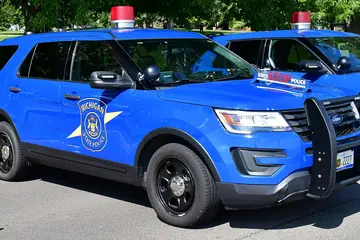
The distinction matters because the two are at very different stages. Hybrids are already the default: the 3.3L full hybrid is the standard powertrain on the model year 2026 Ford Police Interceptor Utility, with the 3.3L V6 and 3.0L EcoBoost gasoline engines as options. Battery-electric models are newer and fewer:
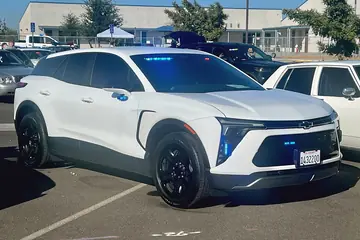
- Chevrolet Blazer EV PPV: tested by the Michigan State Police (MSP) for model year 2026; General Motors lists the 2027 Blazer EV PPV among its pursuit vehicles.
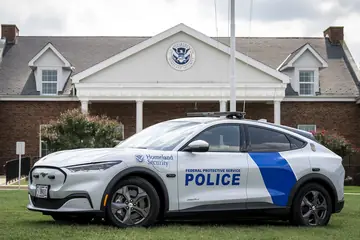
- Ford Mustang Mach-E: announced by Ford in September 2021 as "the first all-electric vehicle to pass Michigan State Police tests." Ford's announcement does not call it pursuit-rated, and I Go Cars classifies it as a special service vehicle.
- Ford F-150 Lightning SSV: offered in 2023 as a special service (non-pursuit) pickup.
Electric police vehicles are not a new idea. Wikipedia records that "The first police car was an electric wagon used by the Akron Police Department in Akron, Ohio, in 1899," with a reported top speed of 16 mph and about 30 miles per charge; those details are secondary and unconfirmed.
Hybrids: why police duty suits them
Police vehicles idle for long periods to run lights, radios and computers. A conventional engine burns fuel the whole time. Ford explains that its hybrid "reduces engine idle time by shutting off the engine and powering the high electrical loads of a police vehicle with its lithium-ion battery." The engine restarts when the battery needs charging.
The fuel figures from three sources point the same way, though they measure different things:
- Ford telematics (model year 2020-2021 Police Interceptor Utilities, about 1,700 vehicles and more than 250,000 trips): 0.75 gallons per hour of vehicle use for the hybrid, against 1.23 gallons for the 3.3L gasoline engine.
- EPA estimates (model year 2026, as printed by MSP): 21 city, 24 highway and 23 combined mpg for the Police Interceptor Utility Hybrid AWD, against 17, 24 and 19 for the 3.3L AWD.
- Los Angeles County Sheriff's Department (LASD) real-world driving (2021 results reused in the model year 2023 booklet): 20 mpg for the hybrid and 18 mpg for the 3.3L.
The gap is widest in the idle-heavy measure and smallest on the highway, which is the pattern one would expect if idling is where the hybrid saves fuel. Ford claims potential savings of about 2,800 gallons per vehicle per year; that is a manufacturer estimate built on assumed fuel prices, not a measured result.
Ford calls the Police Interceptor Utility Hybrid AWD "the only pursuit-rated hybrid SUV." It dates its hybrid police history to 2017, when it revealed "its industry first pursuit-rated hybrid police car and pickup truck," followed by the hybrid Police Interceptor Utility in 2020. Pursuit-rated is a manufacturer designation; MSP states that no sanctioning body defines it.
The battery-electric models compared
The two battery-electric patrol vehicles in MSP's model year 2026 program differ in size and purpose. The figures below are manufacturer specifications as printed in the MSP test book, not MSP measurements.
- Ford Mustang Mach-E GT eAWD: 480 hp and 600 lb-ft; 91 kWh usable battery; 270 miles of EPA-estimated range; 124 mph limited top speed; 978 lb payload; 4,952 lb curb weight; EPA ratings of 95 city, 85 highway and 90 combined MPGe.
- Chevrolet Blazer EV PPV AWD: 498 hp and 571 lb-ft; 102 kWh battery; 286-mile range (GM rating); 130 mph limited top speed; 904 lb payload; 5,870 lb curb weight; available with a NACS (Tesla Supercharger) adapter.
Battery figures vary by model year and source. LASD's model year 2023 booklet described the Mach-E with an "88k Wh" battery and 270 miles of range, against the 91 kWh usable figure MSP printed for model year 2026. Each figure should be read with its year.
Ford's F-150 Lightning SSV sits outside the pursuit category entirely. In 2023 Ford listed it with EPA-estimated ranges of 240 miles (standard range, 98 kWh) or 320 miles (extended range, 131 kWh), and Ford Pro offered AC and DC chargers for agency stations or for officers.
How electric police cars perform in testing
MSP tests every patrol vehicle with a clean roof, meaning no light bar, spotlights or antennas, and warns that equipped vehicles may perform worse. With that caveat, the battery-electric models were among the quickest vehicles tested. In model year 2026 results the Mach-E ran 0-60 mph in 4.03 seconds, the quickest of the 13 patrol vehicles, and recorded the shortest 60-0 stop at 122.45 feet; its top speed was limited to 124 mph. The Blazer EV PPV ran 0-60 in 5.14 seconds, reached 130 mph and stopped in 131.70 feet. MSP's model year 2027 preliminary results show the Mach-E at 4.01 seconds and the Blazer EV at 4.99 seconds and 129 mph; those figures are preliminary and may change.
Charging during the test
The vehicle dynamics test (32 timed laps of a 2-mile road course) exposes the main difference from gasoline cars. According to the MSP model year 2026 test book, manufacturers agreed for the past three years that a charge of about 40 minutes between driver sequences, on a 47 kW charger, would show each vehicle's capabilities under the most favorable conditions. In model year 2026, each driver's eight-lap sequence started at 92% to 99% state of charge and ended at 59% to 71%.
The lap times differed between the two vehicles. The Mach-E's fastest five laps per driver ranged from about 1:34 to about 1:44, while the Blazer EV's stayed within about 1:38.7 to 1:40.6. MSP does not explain the Mach-E's wider spread, and no explanation is offered here.
Heat and power reduction
LASD addressed the issue directly. Its booklet states that "High current power delivery creates heat within the battery," and that manufacturers use thermal management, including reducing current delivery, in a way it compares to the "limp mode" of a gasoline engine; power is also reduced at low state of charge to extend range. LASD therefore split its 32-lap test for battery-electric vehicles into two 16-lap halves with a 90-minute recharge between them. Both agencies changed their procedures to accommodate the vehicles; neither result describes a full patrol shift.
Fitting police equipment into an EV
Performance is only part of a patrol vehicle's job. It must also hold radios, computers, lights and a prisoner partition, and MSP scores how easily that equipment can be installed. Here the two electric models diverged sharply in model year 2026:
- Mach-E: communications score 5.33, the lowest of the patrol vehicles, with dashboard accessibility rated 3.67; ergonomics score 6.30, also the lowest.
- Blazer EV PPV: communications score 8.71, with trunk accessibility rated 6.00.
The Blazer EV PPV was designed with upfit (the police equipment an agency installs after delivery) in mind. GM lists 31 circuits wired to the cockpit and 56 to the cargo area, plus an auxiliary power module to run police equipment. The Mach-E is quick, but its interior was the hardest of the group for MSP's installers to work with.
Cost and service life
The only audited cost data in the research concern hybrids. The Seattle Office of City Auditor's 2022 audit found that the city began buying hybrid Police Interceptor Utilities in 2020 under its Green Fleet Initiative, at about $11,000 more per base vehicle than the gasoline model. Ford estimated annual fuel savings of $3,500 to $5,700 per vehicle. Seattle's fleet division assigns hybrid patrol vehicles a seven-year life against five for gasoline models, and the city's Green Fleet Action Plan aimed for an all-hybrid patrol fleet by 2025.
On those figures a hybrid's purchase premium is offset by fuel savings and a longer service life, but the savings rest on Ford's estimate rather than Seattle's measured fuel use. No comparable audited figures were found for battery-electric patrol vehicles: purchase cost, charging infrastructure cost and maintenance remain unsourced here.
What is not yet known
The research behind this page found no agency pilot of a battery-electric patrol vehicle with documented results. No city council report, fleet study or audit describing real-world range over a patrol shift, charging infrastructure costs or downtime for a Mach-E, Blazer EV or other battery-electric patrol car was located. That absence should be read plainly: it means the outcomes are unreported in the sources gathered, not that pilots have succeeded or failed.
Several specific questions therefore remain open. MSP does not report real-world range under police electrical loads. The test procedures at both MSP and LASD include recharging breaks that a patrol shift may not allow. Ford's 2021 announcement does not state whether it designates the Mach-E police vehicle as pursuit-rated. Readers should treat claims of proven EV patrol economics with caution until agency results are published.
Common misconceptions
- "Electric police cars can't keep up." In MSP testing the Mach-E and Blazer EV PPV were among the quickest to 60 mph. Their constraints are range, charging time and, for the Mach-E, a 124 mph limited top speed and low installation scores.
- "MSP's lap results show an EV can run a full shift." MSP allowed about 40 minutes of charging on a 47 kW charger between driver sequences.
- "The hybrid Police Interceptor is a plug-in." It is a full hybrid; it is never plugged in.
- "Ford's fuel savings are measured results." They are manufacturer estimates based on assumed fuel prices.
Frequently asked questions
Are there electric police cars?
Yes. The Chevrolet Blazer EV PPV and the Ford Mustang Mach-E have both completed Michigan State Police testing, and GM lists the 2027 Blazer EV PPV among its pursuit vehicles. Ford also offered an F-150 Lightning special service vehicle in 2023 for non-pursuit duty. Hybrids are more common: the Police Interceptor Utility's standard powertrain is a hybrid.
How fast is the electric police Mach-E?
The Mustang Mach-E GT ran 0-60 mph in 4.03 seconds in Michigan State Police model year 2026 testing, the quickest of the 13 patrol vehicles tested. Its top speed is electronically limited to 124 mph. MSP tests with a clean roof, so an equipped car may be slower.
How far can an electric police car go on a charge?
Manufacturer ratings are 286 miles for the Chevrolet Blazer EV PPV and 270 miles for the Mustang Mach-E GT. Real-world range under police electrical loads is not reported by the Michigan State Police, and no agency pilot results with measured shift range were found for this page.
Is the Ford Police Interceptor Utility a hybrid?
Yes, the 3.3L full hybrid is the standard powertrain on the model year 2026 Police Interceptor Utility, with 3.3L V6 and 3.0L EcoBoost gasoline engines optional. It is not a plug-in. Ford says it is the only pursuit-rated hybrid SUV, a manufacturer claim.
Why do police departments buy hybrid cars?
Hybrids save fuel at idle, which is where police cars spend much of their time. The battery powers lights, radios and computers while the engine shuts off. Ford's telematics show 0.75 gallons per hour of use for the hybrid against 1.23 for the gasoline 3.3L. Seattle also assigns hybrids a seven-year life against five.
How do police agencies test electric cars?
They modify their procedures to allow for charging. Michigan State Police allowed about 40 minutes on a 47 kW charger between drivers' eight-lap sequences. The Los Angeles County Sheriff's Department split its 32-lap test into two 16-lap halves with a 90-minute recharge, because battery heat can reduce power.
Have police departments reported results from EV pilots?
No documented agency pilot results were found in the research for this page. There were no council reports, fleet studies or audits giving real-world range, charging costs or downtime for battery-electric patrol vehicles. Outcomes should be treated as unreported rather than assumed.
Sources
- Michigan State Police, Precision Driving Unit — 2026 Model Year Police Vehicle Evaluation Program
- Michigan State Police, Precision Driving Unit — 2027 Police Vehicle Evaluation - Live Results (Preliminary)
- Los Angeles County Sheriff's Department — 48th Annual Law Enforcement Vehicle Test and Evaluation Program, Vehicle Model Year 2023
- Seattle Office of City Auditor — Audit of Seattle Police Department Patrol Vehicle Procurement
- policeinterceptor.com/pdf/2023%20Ford%20Police%20brochure.pdf
- gmfleet.com/vehicles/police
- officer.com/vehicles-fleet/vehicles-equipment/vehicles/press-release/2123973…