What a Mach-E police car is, and why it is special service only
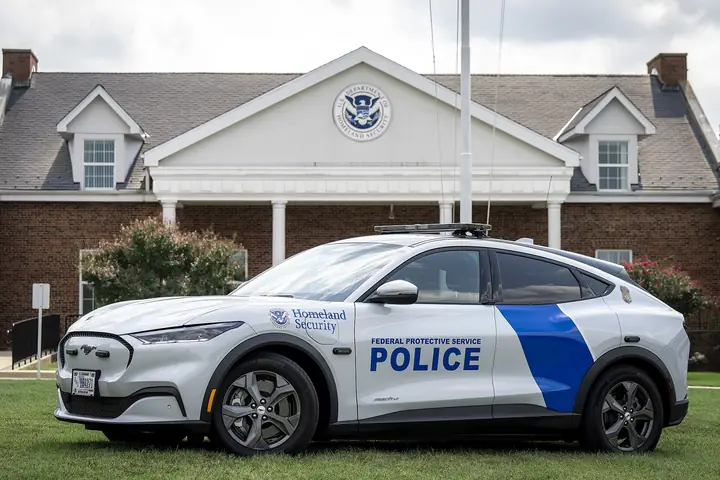
A Mach-E police car is a Ford Mustang Mach-E, Ford's battery-electric crossover SUV, bought by a law enforcement agency and upfitted (fitted with the lights, radios, computers and wiring an agency adds after delivery) for police work. It is not a Police Interceptor. Ford's police vehicles page lists the Mustang Mach-E GT under Special Service Vehicles, a category Ford describes as vehicles "to handle specialized departmental needs that don't require pursuit capability." Ford's pursuit-capable lineup on the same page is the Police Interceptor Utility and the F-150 Police Responder.
The verdict on this page is therefore special service only. The Mach-E is in police service and is still offered to agencies, but Ford does not sell a pursuit-rated Mach-E, meaning one the manufacturer positions for high-speed police driving. That status has been consistent since the vehicle first appeared in police testing. When Ford submitted the first Mach-E to Michigan State Police (MSP) in September 2021, its release described it as "an all-electric police pilot vehicle" and said separately that Ford would also submit "all of its pursuit-rated police vehicles," wording that placed the Mach-E outside that group.
There is no factory Mach-E police package
The most common error about this vehicle is that Ford builds a police version of it. Ford fleet manager Greg Ebel told POLICE magazine in March 2022: "We don't actually have a Mustang Mach-E police package." The magazine added that "the Mustang Mach-E is not a pursuit-rated vehicle" and described it as "a police concept vehicle that Ford is offering as a pilot program." Instead of a package, Ford issued a police modifier bulletin (technical guidance for upfitters) for agencies buying Mach-Es for uses "where civilian vehicles are appropriate." The bulletin covers the electrical system, model selection, and installation of aftermarket lighting, radios and computers.
How it differs from a pursuit-rated police vehicle
A pursuit-rated vehicle such as the Police Interceptor Utility is designed and sold by the manufacturer as a police product. The Mach-E is a civilian vehicle adapted by the agency. The MSP MY2026 spec sheet for the Mustang Mach-E GT eAWD (the GT trim with electric all-wheel drive) shows the difference plainly: it carries no police-package or pursuit-rating language and lists civilian features such as Ford Co-Pilot360 2.0.
The same spec sheet gives the vehicle's key figures:
- Output: 480 combined horsepower.
- Battery and range: a 91 kWh usable battery and "270 EPA-estimated miles of range."
- Curb weight: 4,952 lb.
- Maximum payload: 978 lb.
- Top speed: "Manufacturer Limited Top Speed: 124 mph."
Upfitting is done by agencies or by commercial upfitters working from Ford's bulletin. One example: Cyberkar Systems upfitted a Mach-E for Repentigny, Quebec, and described the cost as "very comparable to an ICE vehicle" (an internal-combustion vehicle), as reported by Ford Authority. That is one upfitter's statement, not a general cost finding.
Performance: what Michigan State Police testing shows
MSP figures are clean-roof test results, meaning the vehicle was tested without a lightbar, spotlights or antennas; MSP states that performance with emergency equipment installed may be lower. Passing MSP's tests does not make a vehicle pursuit-rated. MSP's MY2026 book states that "Meeting the above criteria does not certify a vehicle as being pursuit rated" and that there is "no sanctioning body" for the term.
2022 model year: the first EV to pass
Ford Pro submitted the Mach-E pilot vehicle, based on the 2021 Mustang Mach-E, to the MSP 2022 model year evaluation on September 18 and 20, 2021. On September 24, Ford announced it was "the first all-electric vehicle to pass" the evaluation, which covers acceleration, top speed, braking, high-speed pursuit and emergency-response handling. Ford's release did not state a pursuit rating, availability or agency customers, and did not name the pilot's trim. POLICE magazine reported the results as 0-60 mph in 4.03 seconds, 0-100 mph in 11.94 seconds, a 124 mph top speed and a projected 125-foot stop.
2024 model year
Ford's police page cites MY2024 MSP results in which the "2024 Mustang Mach-E Select eAWD SUV with extended-range battery had the fastest overall average 0-60 mph" and 0-100 mph times, plus the fastest single lap, of the police vehicles tested. That is Ford's summary of the results.
2026 model year
MSP tested 13 patrol vehicles and five motorcycles for MY2026. The Mustang Mach-E GT eAWD was the quickest patrol vehicle in the book:
- Acceleration: 0-60 mph in 4.03 seconds and 0-100 mph in 10.63 seconds, reaching 100 mph in 0.19 mile.
- Top speed: 124 mph, reached at 0.55 mile in 21.82 seconds.
- Braking: MSP's test book shows a Phase I average deceleration of 31.95 ft/s². OFFICER magazine (December 16, 2025) reports an overall average of 31.62 ft/s² and a projected stop from 60 mph of 122.45 feet; that overall figure could not be read directly from the book for this page.
For comparison in the same book, the Chevrolet Blazer EV PPV, which is designated as a pursuit vehicle, ran 0-60 mph in 5.14 seconds and reached 130 mph. The F-150 Police Responder, the quickest gasoline vehicle, ran 5.68 seconds and 121 mph.
Who uses the Mach-E, and in what roles
New York City
The largest documented purchase was an emergency-vehicle purchase (a fleet order for law enforcement and emergency-response agencies) by New York City's Department of Citywide Administrative Services (DCAS). On December 29, 2021, DCAS announced orders for 184 Mach-Es, spending $11.5 million on initial orders, a dated figure. The vehicles went to eight agencies: the NYPD, the NYC Sheriff's Office, the Department of Correction, Parks, the Department of Environmental Protection, NYC Emergency Management, DCAS Police and the Office of the Chief Medical Examiner. The release names the "Mustang Mach-E GT" and also refers to "Sport Crossover Utility Vehicles," and says nothing about pursuit. POLICE magazine cites both 184 and 148 in connection with the NYPD, so the number actually assigned to the NYPD is not confirmed.
Michigan State Police
MSP put its first battery-electric patrol vehicle, a 2024 Mustang Mach-E, into service on January 13, 2025. It is used by state properties security officers in the Lansing area rather than in road patrol, and MSP cited charging availability in downtown Lansing; the agency says it will "study the vehicle's performance long-term." Michigan Capitol Confidential reported in February 2025, citing records it obtained, that the state pays $1,062 a month to lease that vehicle, a dated figure for one lease.
Connecticut, and the Westport error
The Connecticut department with a Mach-E is Wethersfield, whose police operate an unmarked Mach-E (shown June 3, 2023). Westport is often named instead, and that is wrong: Westport Police use Teslas, starting with a Model 3 bought in 2019 and including a Model Y by 2023.
Reports not confirmed by agency documents
Ford Authority has reported Mach-E use by the FBI Police, the Department of Homeland Security and the U.S. Embassy in Warsaw. No primary agency documents were found, so those uses are reported here only as trade-press accounts.
Where the Mach-E is a poor fit
The Mach-E's test numbers are impressive, and they are also easy to misread. Several sourced facts limit where it makes sense:
- Agencies whose policy requires a pursuit-rated vehicle. Ford positions the Mach-E for uses that "don't require pursuit capability." An agency that requires a pursuit-rated vehicle for patrol has no Mach-E option from Ford.
- High top-speed work. The 124 mph figure is a manufacturer limit, below the Blazer EV PPV's 130 mph and well below the 148 mph the Police Interceptor Utility 3.0L reached in MSP MY2026.
- Equipment-heavy builds. The Mach-E's maximum payload is 978 lb, while the F-150 Police Responder is listed in the same MSP book with 1,950 lb. It is an inference, not a tested finding, that an equipment-heavy patrol build may approach the Mach-E's margin; agencies weigh their own upfit.
- Charging-limited locations. MSP itself assigned its Mach-E to security duty at state facilities rather than road patrol, citing charging availability.
Where the mission does not require pursuit capability, such as the facility security duty MSP assigned its own Mach-E, the vehicle fits the role Ford defined for the Special Service Vehicle category.
Common misconceptions
The Mach-E is a pursuit-rated police car
It is not. Ford's police vehicles page lists the Mach-E GT as a Special Service Vehicle, and Ford's fleet manager said in 2022 that there is no Mach-E police package.
Passing MSP testing makes a vehicle pursuit-rated
MSP says the opposite: meeting its criteria "does not certify a vehicle as being pursuit rated," and no sanctioning body defines the term. The Mach-E passed MSP testing in 2021 and remains a Special Service Vehicle.
Its 124 mph top speed is a performance limit
The MSP spec sheet lists 124 mph as a manufacturer-limited top speed, a ceiling set by the manufacturer, so it says nothing about how fast the vehicle could go without that limit.
All 184 New York City Mach-Es are NYPD patrol cars
The DCAS announcement spread them across eight city agencies.
Westport, Connecticut uses Mach-E police cars
Westport's police EVs are Teslas, as NBC Connecticut reported in 2019. The Connecticut Mach-E department is Wethersfield.
Frequently asked questions
Is the Mustang Mach-E a pursuit-rated police car?
No. Ford lists the Mustang Mach-E GT in its police lineup as a Special Service Vehicle, a category for specialized departmental needs that do not require pursuit capability. Ford's pursuit-capable police vehicles are the Police Interceptor Utility and the F-150 Police Responder. The Mach-E has passed Michigan State Police testing, but that does not make it pursuit-rated.
Does Ford make a Mach-E police package?
No. Ford fleet manager Greg Ebel told POLICE magazine in March 2022, "We don't actually have a Mustang Mach-E police package." Agencies buy the vehicle and upfit it themselves or through upfitters, using a police modifier bulletin Ford issued in 2021 that covers the electrical system and installing lighting, radios and computers.
Did the Mach-E pass Michigan State Police testing?
Yes. Ford announced in September 2021 that its Mach-E police pilot vehicle was the first all-electric vehicle to pass the Michigan State Police evaluation, for the 2022 model year. The Mach-E GT eAWD was tested again for the 2026 model year, when it was the quickest patrol vehicle in the book.
How fast is the Mach-E police car?
In Michigan State Police testing for the 2026 model year, the Mach-E GT eAWD ran 0-60 mph in 4.03 seconds and 0-100 mph in 10.63 seconds, the quickest of all patrol vehicles tested, in clean-roof condition. Its top speed was 124 mph, which the MSP spec sheet lists as a manufacturer-limited figure.
Does the NYPD use Mustang Mach-Es?
Yes, as part of a larger city order. New York City's DCAS announced orders for 184 Mach-Es in December 2021 for the NYPD and seven other city agencies, including the Sheriff's Office, Department of Correction and Parks. The exact number assigned to the NYPD is not confirmed, because published sources cite different figures.
Does Michigan State Police use a Mach-E?
Yes, one. MSP put a 2024 Mustang Mach-E into service on January 13, 2025 as its first battery-electric patrol vehicle. It is assigned to state properties security officers in the Lansing area rather than road patrol, and MSP says it will study the vehicle's performance over the long term.
Sources
- Michigan State Police, Precision Driving Unit — 2026 Model Year Police Vehicle Evaluation Program
- michigan.gov/mspnewsroom/news-releases/2025/01/13/state-police-pilots-first-…
- ford.com/police-vehicles/
- nyc.gov/site/dcas/news/21-020/city-makes-largest-electric-vehicle-purchase-l…
- fromtheroad.ford.com/us/en/articles/2021/tough-enough-for-law-enforcement-mu…
- officer.com/vehicles-fleet/vehicles-equipment/vehicles/press-release/2123886…
- nbcconnecticut.com/news/local/westport-police-buys-first-tesla-squad-car-in-…