The short answer: a Ford name, not a category
A Police Interceptor is a Ford police-package vehicle (a vehicle the manufacturer builds with duty-specific engine, cooling, electrical, brake and interior content). The phrase is not a generic label for any patrol car: Ford's 2023 Police and Special Service Vehicles Guide lists "Police Interceptor" and "Police Responder" among the marks that are trademarks of Ford Motor Company.
That single fact corrects the most common belief about the term. Other manufacturers sell law-enforcement vehicles under their own names. Chevrolet uses PPV, which the Michigan State Police (MSP) test book defines as Police Pursuit Vehicle, as in the Tahoe PPV and Silverado PPV. Dodge uses Pursuit, as in the Durango Pursuit. A Chevrolet Tahoe in agency service is therefore a law-enforcement vehicle, but it is not a Police Interceptor.
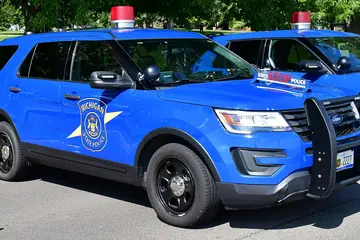
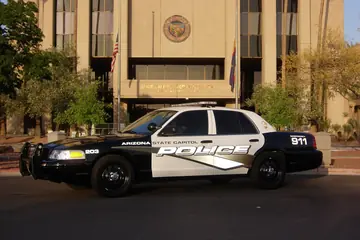
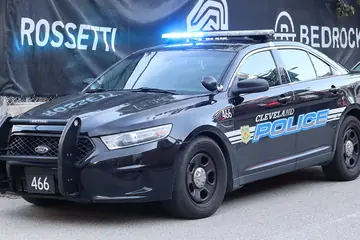
The name has also covered more than one Ford. It has been applied to the Crown Victoria, to the Taurus-based Police Interceptor Sedan and to the Explorer-based Police Interceptor Utility (often shortened to PIU). According to Wikipedia's article on Ford police vehicles, the Utility is the only Police Interceptor in production as of 2025, so a reader who sees the term on a current patrol vehicle is almost always looking at the Explorer-based model.
Where the Interceptor name came from
Ford's own history of its law-enforcement vehicles, published in 2024, says Ford was "the first manufacturer to offer a Police package vehicle," in 1950. A 125-horsepower V-8 followed as a package option in 1952, and Ford states that "the first police model to use the Interceptor name was introduced in 1954."
The sources do not agree on the first use. Wikipedia says Ford named an optional flathead V-8 the "Interceptor" in 1951. Ford's article gives 1954 for the first police model to carry the name. Both are reported here because the record does not settle the question; the two dates may describe an engine name and a vehicle name respectively, but no source read for this page says so.
The modern line
The modern use of the name is easier to date. Ford says the redesigned LTD Crown Victoria was offered with a police package in 1983 and that the Crown Victoria "became its own model in 1992." Wikipedia identifies the 1992 Crown Victoria Police Interceptor as the first Ford vehicle to use the name in its current form and says Police Interceptor has been Ford's main duty nameplate since then. By Ford's count, the Crown Victoria police package "accounted for 85% of police pursuit sales in the U.S. and Canada" in 1998.
The end of the Crown Victoria is recorded two ways. Ford's article says the Crown Victoria Police Interceptor "was retired in 2012." A 2022 Seattle Office of City Auditor report refers to Ford's 2011 retirement of the Crown Victoria. Both wordings are given here; neither source explains the one-year difference.
For model year 2013 Ford introduced two replacements: the Police Interceptor Utility and the Police Interceptor Sedan. Ford describes them as "the only all-wheel-drive vehicles built specifically for law enforcement at the time." Wikipedia reports that the Sedan was discontinued in March 2019 and that the Utility entered its second generation for model year 2020.
What makes a Police Interceptor different from an Explorer
The current Police Interceptor Utility is built on the Explorer platform, but it is not an Explorer with lights bolted to the roof. MSP's general description of these packages applies here: each "has been modified from a civilian vehicle to perform better under the rigors of police use," with possible changes "to engines, cooling systems, Transmissions and shifting parameters, brakes, tires, stability control programming, and other changes." Ford's 2023 guide itemizes what that means for the Utility:
- Cooling: a heavy-duty system with a high-capacity radiator, engine oil cooler and transmission fluid cooler, plus a "police-calibrated fan and grille" for pursuit and long idling.
- Electrical: a 220-amp DC/DC converter on the standard hybrid and a 250-amp alternator on the optional gasoline engines, sized "for lights, radios, computers and other onboard electrical equipment."
- Brakes: heavy-duty ABS disc brakes that Ford says were developed in association with the Los Angeles County Sheriff's Department (LASD) and MSP, with vented rotors and pads chosen for high thermal capacity.
- Chassis: heavy-duty steering and suspension, stiffened gas-pressurized shocks, extra-large hubs and bearings, and an available underbody deflector plate.
- Wheels and tires: 18-inch heavy-duty steel wheels on police tires, with a full-size spare carrying its own tire-pressure sensor.
- Interior: front seats with foam "sculpted for officers' utility belts," steel anti-stab plates in the front seat backs, vinyl rear seats and heavy-duty vinyl flooring, with available inoperable rear door handles for occupant containment.
- Upfit provisions: a column-mounted shifter that "frees up the center console" for equipment, a console mounting plate and wiring conduit, four remappable steering-wheel switches, and pre-wiring packages for grille lights, siren and speaker. Upfit means the lights, partition, consoles and wiring an agency adds after delivery.
- Instruments: a certified speedometer and an odometer that also reports engine idle hours.
The manufacturer highlights in the MY2026 MSP book add standard "police engine idle, police perimeter alert and police dark car" features, and an optional automatic emergency braking system with a "unique temporary disable switch for law enforcement." The sources read for this page do not define the dark car feature, so its exact function is not described here.
Ballistic protection is a frequent question. Ford lists NIJ (National Institute of Justice) Level III+ or Level IV+ ballistic front-door panels as available equipment, not standard equipment. A Police Interceptor is not bulletproof by default.
The 75-mph rear-impact standard
One engineering target separates the Police Interceptor Utility from its civilian sibling more clearly than any other. Ford states that "the Police Interceptor Utility is 75-mph rear-impact crash tested," and the MY2026 MSP highlights repeat that it is "designed and engineered for the 75 mph rear-impact crash test." The test reflects a hazard specific to roadside enforcement work: a patrol vehicle stopped on a highway shoulder can be struck from behind at speed.
A footnote in Ford's guide carries a detail that matters to upfitters and to later owners. The full-size spare in its factory location "is necessary to achieve police-rated 75-mph rear-impact crash-test performance attributes." An agency that relocates the spare to make room for equipment, or a private buyer who removes it, changes the configuration Ford describes for that rating.
Powertrains and how the Utility performs
The 3.3-liter hybrid is the standard Police Interceptor Utility powertrain, with a 3.3-liter V6 and a 3.0-liter EcoBoost V6 as options, according to the Michigan State Police MY2026 test book. Ford calls the hybrid "the only pursuit-rated hybrid SUV." Pursuit-rated is the manufacturer's own designation for high-speed duty use; MSP notes that no sanctioning body or specific performance criteria define the term.
MSP tests every patrol vehicle with a clean roof, meaning no light bar, spotlights or antennas, and warns that equipped vehicles may perform lower than reported. On that basis, the MY2026 PIU 3.0L EcoBoost AWD reached 0-60 mph in 5.95 seconds and a top speed of 148 mph, the highest top speed of the 13 patrol vehicles MSP tested that year. MSP's preliminary MY2027 results show 6.26 seconds and 148 mph for the same configuration; those figures are labeled preliminary and update as data is entered.
Fuel use is where the hybrid earns its place in Ford's argument. LASD measured 20 mpg for the PIU Hybrid and 18 mpg for the PIU 3.3L in real-world driving, figures its MY2023 booklet carried over from 2021 testing. Ford's own telematics claim is larger: 0.75 gallons per hour of vehicle use for the hybrid against 1.23 for the 3.3L gasoline engine, achieved by shutting the engine off at idle and running the duty electrical loads from the battery. Ford's dollar savings projections rest on assumed fuel prices of $2.75 to $4.00 per gallon and should be read as marketing estimates.
How agencies have adopted it
The Utility's rise is visible in agency records. Seattle's 2022 city audit reports that the Seattle Police Department selected the PIU in 2013, after Ford retired the Crown Victoria, and operated 272 PIUs at the end of 2020. A 2020 report by Washington's Joint Legislative Audit and Review Committee found that the PIU made up over 70% of the Washington State Patrol pursuit fleet.
Ford says the Utility is "designed and engineered in Dearborn and assembled in Chicago." The vehicle that leaves the plant is only part of what an agency fields, however. Lights, partitions, radios and computers are added afterward, and that upfit can cost as much as the vehicle itself.
What people get wrong about the term
- "Police Interceptor means any police car." It is a Ford name. Ford lists it as a trademark of Ford Motor Company in its 2023 police guide; Chevrolet and Dodge use PPV and Pursuit.
- "Police Interceptor means Crown Victoria." The Crown Victoria is the most familiar carrier of the name, but the Taurus-based Sedan and the Explorer-based Utility carried it too.
- "A police car is a civilian car with lights." MSP describes changes to engines, cooling, transmissions, brakes, tires and stability control in these packages, and Ford's list for the Utility runs from radiators to seat foam.
- "An Interceptor badge proves a police past." This is not verified either way. Police Interceptor emblems are sold separately as aftermarket parts, so a badge alone proves little. Build data tied to the VIN is a more reliable record than a badge, and a careful buyer checks it.
- "Police Responder means non-pursuit." Ford's second duty nameplate is not a simple signal of role: Ford markets the F-150 Police Responder as pursuit-rated.
Ford's account of the name's history is set out in its 2024 article, The long history of Ford police vehicles.
Frequently asked questions
What does Police Interceptor mean?
Police Interceptor is Ford's name for its law-enforcement package vehicles, and Ford lists it as a trademark of Ford Motor Company in its 2023 vehicle guide. It has been used on the Crown Victoria, the Taurus-based Police Interceptor Sedan and the Explorer-based Police Interceptor Utility. It is not a generic term for every patrol car.
Is a Police Interceptor just an Explorer?
No. The Police Interceptor Utility is built on the Explorer platform but carries heavy-duty cooling, brakes and suspension, a 250-amp alternator or 220-amp DC/DC converter, a column shifter, duty seats and engineering for a 75-mph rear-impact crash test, according to Ford's 2023 guide and the MSP MY2026 test book.
When did Ford start using the Interceptor name?
The sources disagree. Ford says the first police model to use the Interceptor name was introduced in 1954, while Wikipedia says Ford named an optional flathead V-8 the Interceptor in 1951. The modern Crown Victoria Police Interceptor dates to 1992, when the Crown Victoria became its own model.
Do Chevrolet and Dodge make Police Interceptors?
No. Police Interceptor is a Ford name. Chevrolet sells its law-enforcement models as PPVs, such as the Tahoe PPV and Silverado PPV, and Dodge sells the Durango Pursuit. People sometimes call any patrol vehicle an interceptor, but the trademarked nameplate belongs to Ford.
Is the Police Interceptor Utility a hybrid?
Yes, the 3.3-liter hybrid is the standard powertrain on the current Police Interceptor Utility. A 3.3-liter V6 and a 3.0-liter EcoBoost V6 are optional, according to the MSP MY2026 test book. Ford describes the hybrid as the only pursuit-rated hybrid SUV.
Are Police Interceptors bulletproof?
Not by default. Ford lists ballistic front-door panels rated to NIJ Level III+ or Level IV+ as available options, not standard equipment. A Police Interceptor without those panels offers no special ballistic protection, and an agency decides whether to order them for its fleet.
Is the Crown Victoria still a Police Interceptor?
No, the Crown Victoria Police Interceptor is out of production. Ford says it was retired in 2012, while Seattle's 2022 audit refers to Ford's 2011 retirement of the model. Since model year 2013 the name has been carried by the Explorer-based Utility and, until 2019, the Taurus-based Sedan.
Sources
- Michigan State Police, Precision Driving Unit — 2026 Model Year Police Vehicle Evaluation Program
- Los Angeles County Sheriff's Department — 48th Annual Law Enforcement Vehicle Test and Evaluation Program, Vehicle Model Year 2023
- Seattle Office of City Auditor — Audit of Seattle Police Department Patrol Vehicle Procurement
- Washington State JLARC — Washington State Patrol Pursuit Vehicle Replacement (Report 20-05)
- Michigan State Police, Precision Driving Unit — 2027 Police Vehicle Evaluation - Live Results (Preliminary)
- policeinterceptor.com/pdf/2023%20Ford%20Police%20brochure.pdf
- fromtheroad.ford.com/us/en/articles/2024/the-long-history-of-ford-police-veh…
- en.wikipedia.org/wiki/Ford_police_vehicles