What the Mustang SSP was, and why it is out of production
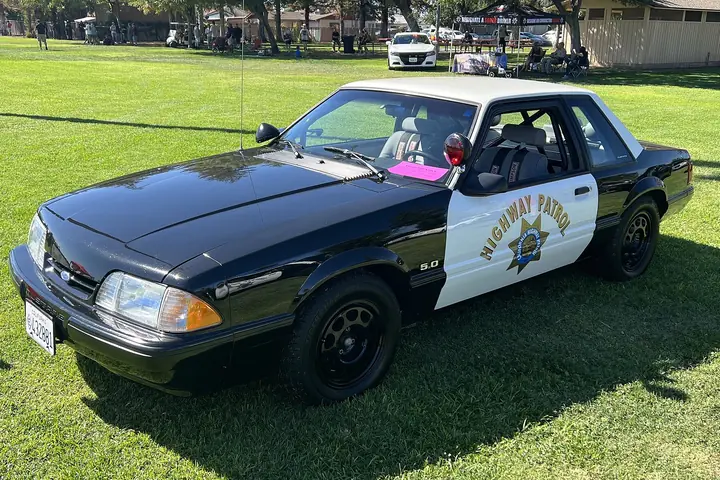
The Ford Mustang SSP was a police-specification Mustang. SSP stands for Special Service Package, the factory option code Ford offered on the Fox-platform Mustang (the Mustang generation built on Ford's Fox chassis, often called the Fox-body) from the 1982 model year through 1993, in two-door coupe and hatchback body styles. It was not a separate model line. It was a regular-production Mustang 5.0 ordered with an option package that added police-duty equipment.
The verdict on this page is out of production. According to Special Service Mustang.net, an owner-registry history site, the SSP option ended with the 1993 model year, when the redesigned SN-95 Mustang arrived for 1994. Ford has no current fleet page for the SSP. Most cars have long been retired from duty; Wikipedia notes that a few remain on police rosters as display or DARE cars, and that "most examples have found their way into either racing or restoration."
Because the SSP is now a collector car, the questions readers bring to it are historical and practical: why police wanted a Mustang, how fast it really was, how many were made, and how to tell a genuine SSP from a civilian notchback dressed in police colors.
Why the California Highway Patrol asked for a Mustang
The SSP began with one agency. According to Wikipedia, the California Highway Patrol (CHP) asked Ford "to produce a capable and lightweight police car." Wikipedia ties the request to two problems: the bulk of the full-size Ford LTD/Crown Victoria and the Fairmont then in police use, and camshaft and engine problems that CHP experienced with Camaros at pursuit speeds.
Special Service Mustang.net describes the sequence. In 1982 the CHP asked Ford for high-speed enforcement Mustangs and received at least one "police demo" coupe for testing, and Ford named the option the Special Service Package. The CHP became the first purchaser.
The first CHP order is not a settled number
Sources disagree on the size of the CHP's first-year (1982) order, and both versions are given here:
- Special Service Mustang.net gives 400 coupes, and says the last six may have been cancelled and never built.
- Government Fleet (November 3, 2021) gives 406 cars ordered for the 1982 model year at $6,868 each, a 1982 contract figure.
No CHP primary document was found to resolve the difference.
The program's legacy remains visible. In 2021, CHP and Ford marked its 40th anniversary with a car based on the then-current Mustang GT (5L Coyote V-8, six-speed manual), shown alongside a 1982 CHP car that was retired in 1985.
What made an SSP different from a civilian Mustang 5.0
The SSP was built from the production 5.0L Mustang; Wikipedia describes Ford "taking the Fox 5.0 Mustangs in production at the time" as the base. The differences were in the duty equipment rather than the engine rating. Sources list the following SSP content:
- Cooling: an engine oil cooler, and a transmission fluid cooler on cars with automatic transmissions (Hagerty; Wikipedia).
- Electrical: heavy-duty alternators and radio noise suppression (Hagerty; Special Service Mustang.net).
- Structure: reinforced floor pans (Hagerty; Wikipedia).
- Equipment: a full-size spare tire, single-key locking ("one key fits all"), a relocated decklid release and a certified-calibrated speedometer (one calibrated and certified for accuracy) (Hagerty; Special Service Mustang.net).
Wikipedia records that the certified speedometers read to 140 mph from 1982 to early 1989 and to 160 mph from late 1989 to 1993.
Output figures varied over the 12 model years, and only one is sourced here. According to Hagerty (March 2020), a 1989 SSP had a fuel-injected 5.0-liter V-8 rated at 225 hp and 300 lb-ft, with a five-speed manual transmission. This page does not state ratings for other years, and the research did not establish whether the 1982 CHP cars were carbureted or fuel injected.
Performance: what the 1987 Michigan State Police tests showed
The Michigan State Police (MSP) has published annual police vehicle evaluations for decades, and its 1987 model year report, dated September 1986, includes the Mustang. MSP results are clean-roof figures, meaning the car was tested without a lightbar or other emergency equipment. The 1987 report is a scanned document read by optical character recognition, so the figures below should be checked against the page image before they are quoted elsewhere.
In MSP's 1987 model year tests:
- Ford Mustang 5.0L five-speed: 0-60 mph in 7.64 seconds; top speed 139.6 mph.
- Ford Crown Victoria 302: 0-60 mph in 11.85 seconds; top speed 109.2 mph.
The gap explains the SSP's reputation. The Mustang was more than four seconds quicker to 60 mph and about 30 mph faster at the top end than the full-size Ford sedan of the same year. MSP's 1987 purchasing qualification standard required 0-60 mph in 12.9 seconds or less and 0-100 mph in 42.3 seconds or less, so the Mustang cleared the acceleration bar by a wide margin. The measured 139.6 mph is consistent with Wikipedia's statement that the cars "were known for their 140+- mile per hour top speed."
The trade-off was space. The SSP was a two-door car, and the research contains no test document measuring its room for prisoners or equipment, so that limitation is noted here only as a consequence of the body style.
Production numbers and the agencies that used it
The commonly repeated total is about 15,000 cars, and it should be read as an estimate. Wikipedia says "nearly 15,000" were built for more than 60 law enforcement and government agencies, and Sports Car Market (September 2013) also gives about 15,000. Special Service Mustang.net, however, calls the roughly 15,000 figure "unconfirmed Ford figures" and reports that Marti Auto Works was still working to confirm exact numbers. No Ford primary document was found.
The same caution applies to the user list. According to Wikipedia, which relies largely on enthusiast-site citations:
- The CHP was the first purchaser, the Florida Highway Patrol the second-largest user and the Texas Department of Public Safety (DPS) the third.
- Other users included the U.S. Air Force (as U-2 chase cars), the DEA, the FBI, the U.S. Border Patrol and the NYPD.
- Saleen modified 14 coupes for the Oregon State Police after that order was cancelled.
None of those rankings or federal uses was confirmed against agency records. Other sources add specific orders. Special Service Mustang.net reports that Texas DPS and Arizona DPS evaluated 1982 coupes, that 1983 orders came from Florida, Georgia, North Carolina, Texas and Washington, and that as many as 40 agencies reportedly ordered 1983 SSPs. Hagerty reports that 32 SSPs went to the Royal Canadian Mounted Police (RCMP), including four delivered to Saskatchewan. Sports Car Market reports that the Missouri State Highway Patrol ordered 25 cars in 1993, the final year.
Buying an SSP today: verification and value
Verify before paying for provenance
Many ex-police and tribute notchbacks exist, and the SSP option leaves a paper trail rather than an obvious badge. Special Service Mustang.net says Marti Auto Works holds Ford documentation, including Eminger invoices, Marti reports and DSO-number confirmation (a Ford order-code record), that can help verify an SSP. Sports Car Market describes one sold car whose documentation was a letter from the agency's motor equipment division plus the window sticker, purchase order and invoice. A car without documents of that kind is a Fox-body Mustang with a story, not a verified SSP.
Do not assume a large premium
SSP provenance does not automatically command much more than a comparable civilian 5.0. In March 2020 a Hagerty valuation expert said "we've never noticed a huge difference in price compared to a base car in similar condition," while adding that "each layer of rarity can potentially add more value to the right buyer." Two dated records illustrate the point; neither is a current price:
- A 1993 Missouri State Highway Patrol SSP sold for $13,910 including buyer's premium at Mecum's 2013 Original Spring Classic (Lot F159). Sports Car Market valued it at $10,000 to $20,000, gave it an investment grade of D, and called it more an "awfully expensive homage" than a practical buy.
- In March 2020, Hagerty's valuation tools listed an average of $7,600 for a #2 (Excellent) condition 1989 Fox-body LX, the civilian base car rather than an SSP.
For a buyer who wants a quick, period-correct Fox-body, the SSP's police history adds interest but, on the sourced evidence, not necessarily resale value. For a buyer paying for the history, documentation is the asset.
Common misconceptions
About 15,000 is an official production figure
It is not confirmed. The Special Service Mustang.net history describes it as unconfirmed Ford figures, and every published version traces back to the same unverified source.
The CHP's first order is a single known number
Published sources give 400 (with the last six possibly unbuilt) and 406. Both are cited above.
Any ex-police notchback is an SSP
Only Ford build documentation or agency paperwork establishes that. Paint, decals and equipment can be added to any Fox-body Mustang.
SSP history always means a much higher price
Hagerty's valuation expert said in 2020 that SSPs historically sold close to comparable base cars, a point reported in Hagerty's 2020 article.
The police Mustang was a special engine
The SSP used the production 5.0L V-8. The CHP's request was for a lighter car, not a different engine, and the 1987 MSP evaluation shows how much quicker that package was than the full-size sedan.
Frequently asked questions
What does SSP mean on a Mustang?
SSP stands for Special Service Package, the police option Ford offered on the Fox-platform Mustang from the 1982 through 1993 model years. It was ordered on the regular 5.0L coupe or hatchback and added police-duty equipment such as an engine oil cooler, heavy-duty alternators, reinforced floor pans, a full-size spare and a certified-calibrated speedometer.
Why did the California Highway Patrol use Mustangs?
The CHP asked Ford for a capable, lightweight police car because its full-size sedans were heavy and slow, according to Wikipedia, which also cites engine problems the CHP had with Camaros at pursuit speeds. Ford supplied a test car in 1982, named the option the Special Service Package, and the CHP became the first SSP customer.
How fast was the police Mustang?
In Michigan State Police tests for the 1987 model year, the Mustang 5.0L five-speed ran 0-60 mph in 7.64 seconds and reached 139.6 mph, in clean-roof condition with no lightbar. The Crown Victoria 302 tested the same year needed 11.85 seconds and topped out at 109.2 mph. The figures come from a scanned 1986 MSP report.
How many SSP Mustangs were made?
About 15,000 is the commonly cited total for 1982 to 1993, but it is not confirmed. Wikipedia says nearly 15,000 were built for more than 60 agencies, while Special Service Mustang.net calls the figure unconfirmed Ford numbers and reports that exact counts were still being verified. No Ford primary document was found.
When did Ford stop making the SSP Mustang?
Ford ended the SSP option after the 1993 model year. The redesigned SN-95 Mustang arrived for 1994, and the Fox-platform Special Service Package did not continue with it. Ford has no current fleet page for the SSP, and most surviving cars are now in private hands, restored or raced.
Is an SSP Mustang worth more than a regular Fox-body?
Not necessarily. A Hagerty valuation expert said in 2020 that SSPs historically sold close to comparable base cars in similar condition, though rarity can add value for the right buyer. As a dated example, a 1993 Missouri State Highway Patrol SSP sold for $13,910 including buyer's premium at a 2013 Mecum auction.
How do I verify a real SSP Mustang?
Verification depends on paperwork, not appearance. Marti Auto Works holds Ford records, including Marti reports, Eminger invoices and DSO-number confirmation, that can help confirm an SSP. Agency documents such as a purchase order, invoice, window sticker or a letter from the agency's motor equipment division can also establish a car's police history.
Sources
- Michigan State Police; published by National Institute of Justice — 1987 Model Year Patrol Vehicle Testing
- en.wikipedia.org/wiki/Ford_Mustang_SSP
- specialservicemustang.net/History.html
- hagerty.com/media/?p=7791
- sportscarmarket.com/?p=768086
- government-fleet.com/news/jay-leno-honors-40th-anniversary-of-california-pat…