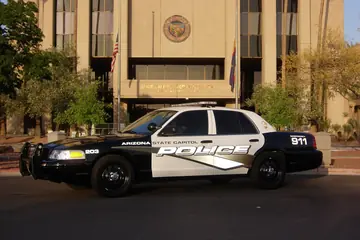
What a retired Crown Victoria Police Interceptor is today
The Crown Victoria Police Interceptor (CVPI, often called the P71 after its Ford code) was never sold new to the public. Every example now offered by a private seller left a government fleet first. Ford stopped accepting orders in April 2011, built the final Police Interceptor in August 2011 for the Kansas Highway Patrol, and ended Crown Victoria production on Sept. 15, 2011, at St. Thomas Assembly in Ontario. Ford replaced it with two vehicles, the Taurus-based Police Interceptor Sedan and the Explorer-based Police Interceptor Utility. The newest CVPI is therefore a 2011 model, and most cars a buyer sees today are 15 years old or more.
That age shapes everything on this page. A buyer is choosing among cars built across two decades of running changes, recalls and service campaigns, then sold as-is by agencies that removed much of what made them police cars. Even the start date is disputed. Ford's own history page says it “debuted the dedicated Police Interceptor” in 1992; a 2026 Police1 history says Ford officially began using the name Crown Victoria Police Interceptor in 1999. Both appear in reputable sources.
Appearance proves nothing either way. From 1999 Ford offered a Street Appearance Package that gave the Police Interceptor chrome trim and Crown Victoria badging so it resembled a civilian car. A plain-looking car can still be a P71, and a civilian car fitted with a spotlight is still a civilian car. The VIN is the starting point.
How to confirm a genuine Police Interceptor from the VIN
The body code sits in VIN positions 5 through 7, the three characters after “2FA” and the restraint-system letter. Ford's 2006 Police Interceptor Modifier Guide identifies “the pursuit-related Police Interceptor (body code P71),” and NHTSA's vPIC decoder (the National Highway Traffic Safety Administration's database built from manufacturers' own VIN-decoding submissions) labels these patterns “Police Interceptor.”
- P71 through MY2009. Patterns such as 2FALP71W (1992-1997), 2FAFP71W and 2FAHP71W decode as Crown Victoria, series Police Interceptor, 4.6L.
- P7B for MY2010 and MY2011. vPIC returns errors for P71 in those years and decodes 2FABP7BV and 2FABP7BW as Police Interceptor. Illinois State Police cars sold in 2015 and 2016 carried VINs beginning 2FABP7BV.
- Position 8 is the engine. W decodes as the 4.6L gasoline V8 and V as the 4.6L flexible-fuel (E85-capable) version, which appears from MY2006.
The P71/P7B change explains a conflict readers often meet. Michigan State Police's MY2011 test book still lists the car under “sales code P71.” The two facts fit together: P71 remained Ford's police order code in that book, while the VIN body code for 2010-2011 police cars is P7B.
Several neighboring codes are not Police Interceptors. P70 is the long-wheelbase Commercial Heavy Duty car, P72 decodes as a fleet or commercial Crown Victoria, P73 is the civilian base car, P74 the LX, and P7A (2011) the livery car. One caution applies to every code: a VIN that decodes as “Police Interceptor” shows how Ford coded the car at the factory, not that a given car served with police. Paperwork from the selling agency is the stronger evidence.
Model years and what changed
Michigan State Police (MSP) evaluation books, published by the National Institute of Justice, record the running changes a buyer should weigh.
- MY2000: an aluminum metal-matrix driveshaft, improved rear springs, a 130-mph speed limiter and, at police request, removal of the “auto-off” parking brake. Gasoline and CNG (compressed natural gas) versions were offered.
- MY2003, introduced in March 2002: a new hydroformed steel frame, new suspension and rack-and-pinion steering, an all-new brake system with standard ABS, a variable-speed electric cooling fan and a 10-fuse power distribution box for aftermarket equipment. Side airbags became standard after July 2003 on cars with power seats.
- MY2005: “basically unchanged from the 2004 version,” with a 3.27 rear axle standard, a 3.55 optional, and an optional automatic fire suppression system on later-built cars.
The axle ratio matters more than most listings admit. In MSP's MY2011 testing, which uses clean-roof cars with no lightbar or equipment, the 3.27-axle car reached 129 mph and the 3.55-axle car 119 mph, with 0-60 mph times of 9.01 and 8.87 seconds. Wikipedia gives output as 215 hp for 1998-2000, 235 hp for 2001-2002, 239 hp for 2003 and 250 hp for 2004-2011; MSP's 2011 book confirms 250 hp for the final year.
One engine issue belongs to the earlier cars. The 1996-2001 4.6L used a composite (plastic) intake manifold that could crack and leak coolant. Ford issued technical service bulletins, and a class settlement paid toward replacements and extended coverage. A revised manifold arrived for 2003, although Wikipedia reports that its plastic rear heater-hose nipple was also prone to problems. Whether every 1996-2001 police car received a replacement manifold is not documented.
Police recalls by campaign number, and how to check them
NHTSA safety recalls attach to the VIN, not to the owner, and they do not lapse when a car changes hands. The campaigns below name police Crown Victorias specifically.
- 97V-024 (1992-1997 police and taxi): the hood latch striker can wear or detach, so the hood may open while driving.
- 98I-001 (1995-1997 police, taxi and fleet): a safety improvement campaign, not a Part 573 safety recall, for rear brake lines that can wear against the floor pan.
- 98V-322 (1996-1999 police, fleet and natural-gas cars): the lower ball joint bearing can crack; dealers replace both lower ball joints.
- 02I-003 (1992-2003 CVPI, about 350,000 cars): no-cost fuel-tank shields “to help protect the fuel tank in high-speed rear-impact crashes,” plus an optional trunk package for sharp-edged equipment.
- 03V-279 (2003 police and taxi with steel wheels): wheels may crack near the rim weld; all four wheels and the spare are replaced.
- 04V-328 (2003 police, commercial and fleet): fleet loads can overload rear wheel bearings and fracture axle shafts.
- 05V-206 (2003-2005 CVPI and heavy-duty/taxi): an under-body sound insulator can sag onto the catalytic converter and char, smoke or catch fire.
- 13V-385 (2005-2011, about 355,000 cars sold or registered in 22 salt-belt states plus D.C.): corrosion can seize the lower intermediate steering shaft; follow-up 14V-704 re-inspects cars serviced under it.
General Crown Victoria recalls also apply by model year, such as 15V-861 (2003-2005 headlamps), 05V-518 (2005 battery cable fusible link) and 07V-270 (2008 front hub). Rather than work through roughly 150 Crown Victoria campaigns, enter the full 17-character VIN in NHTSA's recall lookup, which reports unrepaired recalls on that car; a Ford dealer can confirm completion records. Because 13V-385 covered salt-belt registrations only, a car that later moved states may still show it open.
What decommissioning leaves on the car
Decommissioning, the agency process of stripping police equipment and markings before sale, removes the valuable and identifying items and leaves the holes. Miami-Dade County's Procedure 812 calls for removal of “all police markings, decals, logos, emergency lighting, computers, prisoner inserts, communication radio equipment” and spotlights, and requires any emergency lighting left behind to be “made inoperable.” Texas law (HB 473, 2015) bars state agencies from selling a marked patrol car to the public until lights, sirens, spotlights, emblems and even the “outline of an emblem” are removed.
Illinois State Police listings for retired CVPIs on the state's iBid surplus site show the result. They warn “THERE MAY BE HOLES WHERE EQUIPMENT WAS MOUNTED” and note antenna and spotlight holes, interior cut-outs, leftover brackets, a lock-out switch, sticker residue and, on a former K-9 car, dog hair. The same listings state “ALL OPTIONS MAY NOT WORK” and sold the cars “As Is” and “With All Faults,” with viewing by appointment. Odometer readings were 118,527 to 133,368 miles on three 2010 cars and 188,520 on a 2007 car: single-agency examples, not an average.
Idle time is the wear the odometer misses. No Ford or MSP source found for this guide confirms that the CVPI records engine idle hours, so that wear cannot simply be read from the car; agency maintenance records, where available, are the only window into it.
Where retired Crown Victorias have been sold
The channels are a matter of record, and none is rated here.
- State online surplus sales. Illinois sold State Police CVPIs through its iBid site, with the title assigned to the buyer.
- Municipal sales through contracted auction firms. A 2017 Town of Atherton, California, staff report described retired 2008 and 2009 Crown Victorias, at about 101,000 and 92,000 miles, as in “poor” condition. The auction firm charged an 8% commission, set no reserves, and unsold vehicles went to salvage.
- Federal and other state or local surplus channels. A federal sale comes with an SF 97 (the U.S. Government Certificate to Obtain Title to a Vehicle); a state or city sale normally comes with a state title.
Prices should be read as history, not as a market value. Three 2010 Illinois cars closed at $880, $1,526 and $1,970 in 2015-2016, and a 2007 at $1,010 in 2015. Those are single-seller results from a decade ago, and no source measures what CVPIs fetch now.
When a Crown Victoria Police Interceptor is a poor choice
The CVPI suits a buyer who wants a body-on-frame, rear-wheel-drive V8 sedan and accepts its age. It is a poor choice in several situations the record supports.
- The buyer needs modern safety technology or a warranty. The newest car is a 2011 model, and Illinois sold its units with all faults and no test drive.
- The car is a pre-2003 model and the buyer expects 2003 hardware. The 2003 redesign changed the frame, steering and brakes. It was structural, not cosmetic.
- Fuel cost matters. The MY2011 car carried an EPA rating of 14 mpg city, 21 highway and 17 combined.
- Recall completion cannot be shown. A 2005-2011 salt-belt car without a record of the 13V-385 steering-shaft repair, or a 1992-2005 car without the 02I-003 tank shields or the 05V-206 insulator repair, leaves open questions about steering and fire.
Owner complaints to NHTSA that mention police use on 1998-2011 Crown Victorias cluster around wheels, the fuel system, the powertrain and steering. They are owner reports, not defect findings, but they suggest where a pre-purchase inspection should start.
Frequently asked questions
How do I know if a Crown Vic is a real Police Interceptor?
Check VIN positions 5 through 7: P71 on police Interceptors through 2009 and P7B on 2010 and 2011 models. NHTSA's vPIC decoder labels both “Police Interceptor.” A decoded pattern shows how Ford coded the car, not that it served with police, so the selling agency's records are the stronger proof. Codes such as P70, P72, P73, P74 and P7A belong to commercial, civilian or livery Crown Victorias.
What is the difference between P71 and P7B?
They are the same police car; Ford's VIN body code changed from P71 to P7B for model years 2010 and 2011. NHTSA's decoder returns errors for P71 in those years. Michigan State Police's MY2011 test book still lists Ford's police order as sales code P71, which is why both codes appear in connection with the final cars.
Is a P72 Crown Vic a police car?
No, NHTSA's decoder lists P72 as a fleet or commercial Crown Victoria, not a Police Interceptor. It may have served in a government fleet, but it was not built under the pursuit-related P71 or P7B body code. P70 is the long-wheelbase Commercial Heavy Duty car, and a 2011 P7A is the livery version.
What recalls apply to a Crown Victoria Police Interceptor?
Police-specific campaigns include 97V-024 (hood latch), 98V-322 (lower ball joints), 02I-003 (fuel-tank shields), 03V-279 (steel wheels), 04V-328 (rear axle), 05V-206 (insulator fire risk) and 13V-385 (steering shaft corrosion). General Crown Victoria recalls also apply by model year. Entering the VIN in NHTSA's recall lookup shows which remain unrepaired on a particular car.
What changed on the 2003 Crown Vic Police Interceptor?
The 2003 car, introduced in March 2002, received a new hydroformed steel frame, new suspension, rack-and-pinion steering and an all-new brake system with standard ABS, according to Michigan State Police. It also gained a variable-speed electric cooling fan and a power distribution box for aftermarket equipment. These are structural changes, which is why buyers treat pre-2003 and later cars separately.
Which axle ratio is better on a P71?
It depends on the goal: in Michigan State Police MY2011 testing the standard 3.27 axle reached 129 mph and the optional 3.55 reached 119 mph. The 3.55 was slightly quicker to 60 mph, 8.87 seconds against 9.01. MSP tests clean-roof cars without lightbars or equipment, so a retired car would not necessarily match those figures.
What does a decommissioned police Crown Vic come with?
Usually holes where spotlights, antennas and equipment were mounted, possible leftover brackets and sticker residue, and as-is terms. Illinois State Police listings warned that all options may not work. Agency rules such as Miami-Dade's Procedure 812 require markings, lighting, computers, radios and prisoner inserts to be removed, and any lighting left in place to be made inoperable.
Sources
- Michigan State Police; hosted by National Institute of Justice (NCJRS) — 2011 Model Year Police Vehicle Evaluation Program
- api.nhtsa.gov/recalls/campaignNumber?campaignNumber=13V385
- api.nhtsa.gov/recalls/campaignNumber?campaignNumber=02I003
- ojp.gov/pdffiles1/nij/nlectc/194666.pdf
- vpic.nhtsa.dot.gov/api/vehicles/DecodeVinValues/2FABP7BV9AX133175?format=json
- nhtsa.gov/recalls
- miamidade.gov/managementandbudget/library/procedures/812.pdf
- ibid.illinois.gov/item.php?id=146711
- athertonca.gov/DocumentCenter/View/4378
- at.ford.com/us/en/home/news-media/news/2025/1/tbt-01-09-2025.html